
How to Sell A House with Squatters In California
Yes, you can sell a house with squatters in California. You do not have to complete the eviction process before selling. A cash buyer like Quick Home Offers® can purchase the property with the squatters still inside and handle the removal after closing. We have bought properties in exactly this situation across California since 2013 — including homes where active squatters refused to leave, and the property owners had already spent months dealing with legal hurdles.
California treats squatters differently depending on how long they have been on the property, and taking the wrong steps — like changing the locks or shutting off utilities — can expose you to liability. This page covers the California-specific laws, the real risks and costs, your three realistic options, and how to sell without going through the eviction process at all. Quick Home Offers® is not a law firm. For specific legal questions, consult a competent, local attorney.

How To Sell A House With Squatters In California – Quick Answer
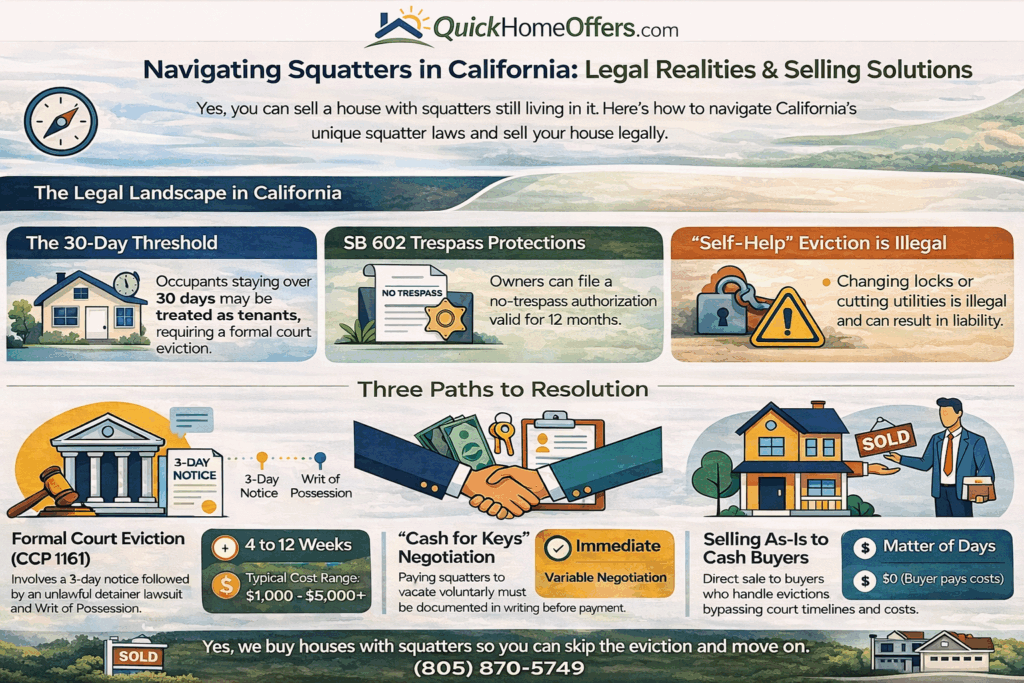
To sell a house with squatters in California, you have three paths: evict them through the courts and sell the property vacant, pay cash for keys to get them out voluntarily, or sell the property as-is to a cash buyer who takes it with the occupants still inside. You do not have to complete the eviction before you sell. A cash buyer can close with the squatters in place and handle the removal after closing.
Your buyer pool is the constraint. Traditional buyers using bank financing cannot finance an occupied home, which limits the market to cash buyers and investors. Most real estate agents will not list a property with active squatters, because showings are unsafe and buyers will not make an offer on a home they cannot inspect.
Which legal path applies depends on how long the occupants have been there. Fewer than 30 days, and they may be removed as trespassers under California Penal Code Section 602. Longer than 30 days, and California law may treat them as month-to-month tenants, which means a formal unlawful detainer eviction is required under Code of Civil Procedure Section 1161. That process typically takes 1 to 3 months if uncontested and costs $1,000 to $5,000 in legal fees and court costs. If the occupants contest the case or file motions, it can extend to 6 months or more.
You are legally required to disclose the presence of squatters to prospective buyers. Squatters are considered a material fact under California disclosure law because their presence directly impacts the property’s value, desirability, and use.
Your three options:
- Formal eviction through the courts — 1 to 6 months, $1,000 to $5,000+ in legal and court costs
- Cash for keys — paying the occupants to leave voluntarily, 1 to 4 weeks, typically $2,000 to $10,000+
- Selling as-is to a cash buyer who takes on the occupants — 2 to 4 weeks, no out-of-pocket cost
Looking to sell a home, multifamily, or land parcel with squatters? We’ve got you covered. Get a free, no-obligation offer now.
Enter your number. We’ll walk through your options — whether you sell to us or not. No fees. No obligation. Serving California since 2013.
You can also call or text us directly at (805) 870-5749 to discuss your options.
Squatters vs. Tenants and Why It Matters In California
Before you do anything, you need to know what you are actually dealing with. California law treats squatters and tenants differently, and confusing the two can cost you months and thousands of dollars.
A squatter is someone who moves into your property without the owner’s permission. A tenant is someone who has had permission at some point — even verbally, even informally. If the person ever paid rent, received a key, or had any kind of agreement with you or a previous owner, they may have tenant protections regardless of whether they are currently paying.
Here is the critical threshold: under California law, if someone has been occupying your property for more than 30 days, they may be treated as a month-to-month tenant by local law enforcement — even without a lease. At that point, police will typically call it a “civil matter” and refuse to remove them. You are now looking at a formal eviction through the courts.
If the person has been there fewer than 30 days, you may be able to have them removed as a trespasser under California Penal Code Section 602.
Is a Non-Paying Family Member a Squatter in California?
No. A family member you allowed to move in is almost never a squatter under California law, even if they stopped paying or never paid at all. The moment you gave them permission to live there, they became a tenant rather than a trespasser, and that single fact changes how you are legally allowed to remove them.
A true squatter enters without permission. A relative who moved in with your blessing did the opposite, whether that is an adult child, a sibling, an aging parent, or an in-law. Because permission was given, the trespass tools that work on squatters, including the SB 602 trespass letter covered above, do not apply to family. California treats your relative as a tenant at will, and a tenant can only be removed through the courts.
That means formal eviction through unlawful detainer is your legal route, not a lockout. The written notice you owe depends on how long they have lived there:
- Less than one year: at least 30 days written notice under California Civil Code 1946.1.
- One year or more: at least 60 days written notice, and possibly a stated reason under California’s just cause rules.
The things people are tempted to try when a family situation turns bitter, changing the locks, shutting off the power, or moving belongings to the curb, are all illegal in California and can expose you to real liability. We explain why in what not to do when selling with occupants.
The hard part is rarely the law. It is that the tenant is someone you love, or used to. Owners in this spot are often heirs who inherited a house with a brother or sister already living in it, or parents who let an adult child stay through a rough patch that never ended. The money and the grief get tangled together, serving your own family an eviction notice feels impossible, and so nothing happens for months while the mortgage, taxes, and insurance keep running.
Here is what most owners do not realize. You do not have to be the one to evict your relative in order to sell. You can sell the house, condo, or multifamily property as-is to a cash buyer who closes with your family member still living inside and takes on the occupancy from there. That lets you step out of the conflict, get your money, and hand the rest to the new owner. It is the same as-is path we describe in your options above, and for a family situation it is often the least painful one.
Because a relative who has lived there more than a year can be covered by additional just cause and relocation rules, and because family history with money involved can raise questions a short section cannot settle, a brief call with a California landlord tenant attorney is worth it before you serve any notice. If a non-paying relative is the reason your California property has become a burden, we buy homes in exactly this condition, occupant and all, and we will walk you through what a sale would look like with no pressure and no judgment.
California Squatter Laws You Must Know
Two sections of California law come up in nearly every squatter situation. Here is what each one means for you as a property owner.
CCP 1161 — Unlawful Detainer
California Code of Civil Procedure Section 1161 is the standard eviction statute. If the squatter is being treated as a tenant (because they have been there 30+ days or claim residency), this is the process you will need to follow. You serve a written eviction notice — typically a 3-day notice to quit — and, in squatter cases, it is smart to have a specialized real estate attorney draft the notice and properly file the unlawful detainer in your local court. The defendant has 5 days to respond after being served.
If they do not respond, you can request a default judgment. If they contest it, the case goes to trial, though unlawful detainer cases sometimes get expedited scheduling. After judgment, you request a Writ of Possession, and the Sheriff posts a 5-day notice, then returns to physically remove the occupants.
The entire process typically takes 1 – 2 months if the occupant does not respond to the lawsuit. Contested cases can take much longer; typically, 3 to 6 months or longer, depending on how hard the squatters fight the eviction.
SB 602 — The 2024 Trespass Letter Law
Senate Bill 602 took effect on January 1, 2024, and it is the most significant recent change for California property owners dealing with squatters. Before SB 602, if you wanted police help removing a trespasser, you had to file a “602 letter” (a no-trespass authorization) with your local sheriff’s department, and that letter expired every 30 days. Miss the renewal by a day, and you have to start over.
SB 602 changed the rules: your trespass letter now stays valid for 12 months. For properties that are permanently closed to the public and properly posted with no-trespass signage, the letter is valid for up to 3 years. You can also file these letters electronically now.
What SB 602 does not do: it does not make squatting a criminal offense (California still treats it as a civil matter once residency is claimed), and it does not speed up the formal eviction process for squatters who have already established occupancy.
Your Options When Squatters Are in Your California Property
Once you have confirmed you are dealing with squatters and not tenants, you have three realistic paths.
| Option | Timeline | Cost to Owner | Best For |
|---|---|---|---|
| Formal Eviction | 1–6 months | $1,000–$5,000+ in legal fees, plus holding costs | Owners who want to list on the open market after removal |
| Cash for Keys | 1–4 weeks | $2,000–$10,000+, depending on location, paid to squatter | Owners who want a fast resolution without court |
| Sell As-Is to Cash Buyer | 2–4 weeks to close | No out-of-pocket cost; sale price reflects occupancy discount | Owners who want to walk away immediately |
Option 1 — Formal Eviction Through the Courts
This is the standard legal path. Serve the notice, file the unlawful detainer, and go through the court process to evict squatters. It works, but it takes 1 to 2 months if uncontested, and 3-6 months or more if they fight it, which can turn into drawn-out legal battles. Evictions cost money ($1,000 to $5,000 in legal fees and court costs, plus holding costs, depending on whether the squatter contests), and require you to manage the situation while the property sits occupied.
For a standard sale, you usually have to legally evict squatters before closing unless a specialized investor is willing to buy the property as-is.
Option 2 — Cash for Keys
This is exactly what it sounds like: you offer the squatter money to leave voluntarily. It avoids the court process entirely and is often faster and cheaper than a formal eviction. The amount varies and depends on your location. For lower cost areas like Bakersfield, Fresno, Sacramento, etc., this amount could be between $2,000 to $5,000. In areas like the Bay Area, this could be $20,000 or more.
Get the agreement in writing before handing over any money. Have them sign a document confirming they are vacating voluntarily, surrendering any claim to the property, and agreeing to a specific move-out date. Do not give money before the squatters have left.
Unfortunately, many squatters are aware of this option, and often abuse the court process to drag things out to get paid.
Option 3 — Sell the Property As-Is with Squatters Still Inside
This is where most people end up when the eviction timeline does not work for their situation. You can sell the property occupied by squatters to a cash buyer who is willing to purchase it as-is and take on the removal process after closing.
Most traditional buyers and lenders will not touch a property with unauthorized occupants. Banks require vacant possession for financing. But a cash buyer who has experience with occupied properties can often set a fast closing date regardless of the occupancy situation.
This is what Quick Home Offers® does. We buy properties with squatters, tenants, or unauthorized occupants and handle the situation during escrow or after the sale closes. The seller does not need to complete an eviction, file a 602 letter, or negotiate a cash-for-keys deal. We take it from there.
Call or text (805) 870-5749 to reach Adam Justiniano to talk through your situation and options, or fill out the form on this page if this is your situation.
Dealing with squatters and want to skip the eviction process? Quick Home Offers® buys California properties with squatters. No repairs, no eviction required, no fees.
Enter your number. We’ll walk through your options — whether you sell to us or not. No fees. No obligation. Serving California since 2013.
How Squatters Affect Your Property’s Value and Marketability
Squatters do not just create a legal problem. They create a real financial one. Understanding the risks and costs involved will help you decide which option makes the most sense for your situation.
Property Damage and Security Risks
Properties occupied by squatters often suffer significant damage. Vandalism, trash accumulation, holes in walls, damaged plumbing, and neglected landscaping are common. Homes left vacant for long periods are especially vulnerable to squatters and should be checked regularly. In some cases, the property becomes a location for drug activity, which can create hazardous conditions that require professional remediation before the home is safe to enter. Every month a squatter remains on the premises, the risk of additional damage grows, and the eventual repair costs increase, adding to the overall risk factors.
Why Most Realtors and Real Estate Agents Will Not List a Squatter Property
Most real estate agents will not take a listing with active squatters, and even a seasoned realtor may view the process as too time-consuming. Showings are unsafe when unauthorized occupants are inside. Buyers cannot inspect the property, and lenders will not finance a home that is not vacant at closing. That eliminates the entire traditional buyer pool.
The only realistic buyers for an occupied property are cash investors who have experience purchasing and managing properties with occupant issues, especially in California, given the tenant-favoring laws. This is why selling to a cash buyer is often the fastest and most practical path, since listed buyers often discount these properties because of costs, legal uncertainty, and risk factors.
The Real Cost of Waiting
While you wait for an eviction to work through the courts or for the squatter to leave on their own, you are still responsible for property taxes, insurance, and any code violations or fines the city issues. If the property has a mortgage, those payments continue regardless of whether squatters are inside. For many homeowners, the holding costs during a 3 to 6 month contested eviction exceed the discount they would have taken by selling as-is on day one. Run the numbers on your specific situation before deciding to wait.
What Selling with Squatters Actually Looks Like
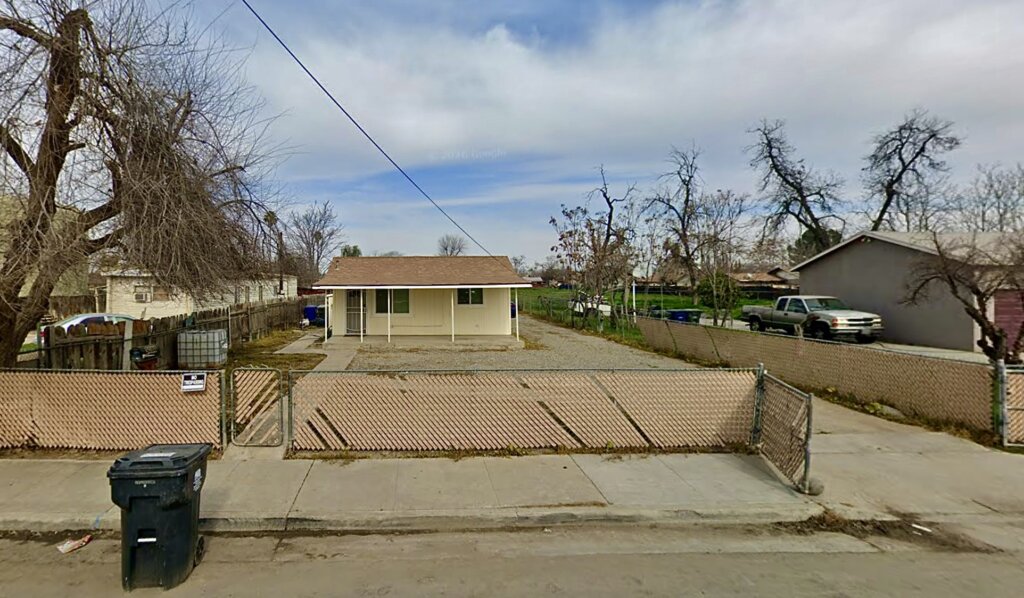
A seller found us online and reached out about a property on Alloway in Bakersfield. She had not visited the house in years and had no idea how bad things had gotten.
There were two structures on the property: a house in the front and a trailer in the back. Her son and his wife were living in the house, not paying rent, and the property had fallen into serious disrepair. A separate occupant was living in the trailer behind the house and had refused to leave for about a year. The seller had tried to get her out on her own and was unsuccessful.
To make things harder, the seller had a medical condition that made it difficult for her to appear in court. The stress of pursuing a formal eviction was taking a real toll on her health.
Adam visited the property and showed the seller the photos of the condition. She made the decision to sell and use the proceeds to help her son and his family get into a better situation.
We purchased the property and handled both occupant situations during the escrow period and after closing. The tenant in the trailer was removed without any payments, legal proceedings, or costs to the seller. We helped the son move his belongings into a storage unit and provided roughly $1,500 to cover the unit and a hotel while his mother’s proceeds cleared escrow. It was a mutual agreement that worked for everyone involved, including the tenant in the trailer, who came out with no eviction on their record.
After closing, the seller used the proceeds to buy a motor home for her son and made improvements on her own primary residence.
What Not To Do When Selling With Squatters: California Self-Help Eviction Is Illegal
This is important enough to call out separately. As frustrating and unfair as it may seem, in California, it is illegal to remove a squatter yourself through what the law calls “self-help eviction.” That means you cannot change the locks, shut off the utilities, remove their belongings, or physically remove them — even if they have no legal right to be there.
If you do any of those things, the squatter can sue you for damages. California courts have awarded significant judgments to occupants who were illegally locked out, even when those occupants had no lease and no permission to be on the property in the first place.
The only legal path to physical removal is through the courts (unlawful detainer) or through law enforcement acting on a valid trespass authorization under Penal Code Section 602.
Adverse Possession in California: Can Squatters Claim Your Property?
Adverse possession is the legal process through which a squatter can claim ownership of someone else’s property. It is one of the biggest fears property owners have when dealing with squatters, but in California, a successful claim is extremely rare.
To claim adverse possession in California, a squatter must meet all five requirements under California Civil Code Section 325: the occupation must be hostile, meaning without the owner’s permission, actual (physically present on the property), open and notorious (visible to anyone, not hidden), exclusive (not shared with the owner), and continuous for at least five years. This is why simply hearing about squatter’s rights does not mean an occupant has a valid claim. On top of all that, the squatter must have paid all property taxes on the property for the full five-year period.
That tax payment requirement is what kills nearly every adverse possession claim. A squatter who broke into a vacant house six months ago has no path to ownership. Even someone who has been living in your property for four years cannot make a claim if they have not paid your property taxes every single year.
In our experience buying over 300 properties across California since 2013, we have never encountered a successful adverse possession claim by a squatter. The cases that succeed typically involve boundary disputes between neighbors, not unauthorized occupants in vacant homes.
That said, do not ignore the situation. The longer a squatter stays, the stronger their argument becomes if the case ever reaches court. Acting quickly protects your legal position and avoids the risk of property damage, code violations, and mounting holding costs.
Protecting a Vacant Property from Squatters
If your property is going to sit vacant — whether you inherited it, are between tenants, or are waiting to sell there are a few things you can do to protect yourself.
File a 602 letter (no-trespass authorization) with your local sheriff’s department. This is Kern County’s 602 letter as an example. Every county or city may have a different form and many need to be notarized. Under SB 602, this stays valid for 12 months and gives law enforcement the authority to remove trespassers without you being present.
Check whether your city requires vacant property registration. Several California municipalities — including Los Angeles and San Francisco — require owners to register properties that have been vacant for a set period (90 days in LA). Registration creates an official record with the city that you are actively managing the property, which can strengthen your legal position if a squatter later claims residency. Not registering your property may even lead to code violations, so check with your local building or housing department for your city’s requirements.
Post visible “No Trespassing” signage at all entry points. Secure doors, windows, and any other access points. If possible, have someone check on the property regularly — an unmonitored property with overgrown landscaping and piling mail is exactly what squatters look for.
Frequently Asked Questions About Selling A Home With Squatters In California
Q: Can you sell a house with squatters in California?
A: Yes. You can sell to a cash buyer who will purchase the property with the occupants still inside. Quick Home Offers® buys properties in this situation across California. If squatters are still occupying the property at closing, your offer will be lower than if the property were vacant. That is true with any buyer, not just us. If you are able to resolve the occupant situation before escrow closes, your offer goes up. If not, we can still close and handle the situation afterward.
Q: How long does it take to evict a squatter in California?
A: The formal unlawful detainer process typically takes 1 to 2 months if the occupant does not respond to the lawsuit. Contested cases can take 3 to 6 months or longer, depending on how hard the squatters fight it. You should also plan for an attorney to handle the filing and service, which adds cost and time.
Q: Do squatters have rights in California?
A: Yes. If a squatter has been occupying the property for more than 30 days, California law may treat them as a month-to-month tenant. At that point, they must be removed through a formal unlawful detainer, not by calling the police or changing the locks. California also has adverse possession laws under Civil Code Section 325 that allow someone to claim ownership after 5 years of continuous occupation with property taxes paid, though this is extremely rare in practice.
Q: Is a family member living in my house rent free a squatter in California?
A: No. If you gave a relative permission to live in the home, they are legally a tenant, not a squatter, even without a lease and even if they never paid. That means you cannot use the trespass process or a lockout to remove them. You have to go through formal eviction with proper written notice, 30 days if they have lived there under a year and 60 days if a year or more. You can also sell the property as-is to a cash buyer who closes with your relative still inside, which lets you avoid evicting your own family. Quick Home Offers® buys occupied homes in this exact situation across California.
Q: What is a 602 letter?
A: A 602 letter is a no-trespass authorization you file with your local sheriff’s department. It gives law enforcement permission to remove trespassers from your property without you needing to be present. Under SB 602, which took effect January 1, 2024, these letters now stay valid for 12 months instead of the previous 30 days.
Q: What is cash for keys?
A: Cash for keys is an agreement where you pay the occupant a set amount to leave voluntarily. It avoids the court process and is often faster than a formal eviction. In California, expect to pay $2,000 to $10,000 or more, depending on the market and situation. Always get the agreement in writing before exchanging money, and do not pay until the occupants have vacated completely.
Q: How much less will I get for my house if I sell it with squatters?
A: If you’re selling a home currently occupied by squatters, expect the property to sell for less than other comparable properties without squatters. Buyers need to account for the costs, the risks, and the time associated with squatters. How much less you get is a function of the property condition, the squatters, and the location. Some areas in California have longer times to evict, which need to be accounted for.
Q: Do I have to disclose squatters to buyers?
A: Yes. Squatters are considered a material fact under California disclosure law. Their presence directly impacts the property’s value, safety, and desirability. Failing to disclose can expose you to post-sale litigation for misrepresentation.
Q: Can squatters claim ownership of my property in California?
A: In theory, yes, through adverse possession. But in practice, it rarely happens. The squatter must occupy the property openly and continuously for at least 5 years and pay all property taxes during that period. The tax payment requirement defeats nearly every claim. In over 300 transactions since 2013, we have never encountered a successful adverse possession claim by a squatter.
Q: Will Quick Home Offers® buy a property with squatters?
A: Yes. We buy houses, multifamily properties, condos, and land with squatters, unauthorized occupants, and difficult tenant situations across California. The seller does not need to complete an eviction before selling to us. We handle the occupant situation after closing. Call (805) 870-5749 to discuss your property.
About the Authors and Quick Home Offers®

Adam Justiniano is co-owner of Quick Home Offers® and works directly with sellers across California. He has personally handled property purchases where squatters were actively occupying the home at the time of closing, including the Bakersfield transaction described in this guide. Adam coordinates with sellers, occupants, and legal counsel to navigate the removal process after the company takes ownership. He has been buying real estate since 2013 and grew up in Ventura County, where he still lives today.

Josh Justiniano is co-owner of Quick Home Offers® and runs the company’s underwriting and project management. On squatter-occupied properties, Josh evaluates the acquisition based on estimated eviction timelines, holding costs, and post-vacancy renovation scope. He worked at a legal firm in Thousand Oaks before entering real estate at 21, which gave him familiarity with the unlawful detainer process that these transactions often require. He went to California State University Northridge and majored in real estate. He and Adam have closed over 300 property purchases across California since 2013.
Quick Home Offers® is a California cash home buying company headquartered in Thousand Oaks, CA. The company purchases houses, condos, multifamily properties, and land statewide, including properties with squatters, unauthorized occupants, and holdover tenants. Their business is built around solving difficult property situations and helping sellers fix problems without repairs or drawn-out timelines. Every offer is personally evaluated by Adam or Josh, not generated by an algorithm. To discuss your property and the next steps, call (805) 870-5749.
We’ll Call You Within 1 Business Day
Enter your number. We’ll walk through your options — whether you sell to us or not. No fees. No obligation. Serving California since 2013.