
Selling an inherited house in California depends on how the property was transferred, whether through a trust, joint ownership, or probate. But if you’ve inherited a house that needs work, the selling question is only part of it. Before you can make any decision — keep it, rent it, or sell it — you need to understand the property’s actual condition, the legal process required to transfer ownership, and what the inherited property will cost you every month while you figure it out.
Many heirs also face additional challenges, including property repairs, ongoing expenses like taxes and utilities, mortgage payments, and potential disagreements between family members. There may also be questions about capital gains taxes, stepped-up basis, and how California’s Proposition 19 affects the property. Understanding the probate process and obtaining an accurate assessment of the property’s value are essential for making informed decisions about your options.
For those who don’t want to deal with cleaning out, repairing, or listing an inherited house that needs work, selling the property as-is can be a simpler and faster option. At Quick Home Offers, we work with California heirs to sell inherited houses, condos, multifamily properties, and land without repairs, showings, or agent commissions.
The experience behind this guide comes from Adam and Josh Justiniano at Quick Home Offers®— over 300 transactions across California since 2013. A significant number of them were inherited properties in exactly the situations described here. For questions about your specific situation, always seek qualified legal or tax advice.

Quick Answer: How to Sell an Inherited House in California
The first step is determining whether the property is held in a trust or needs to go through probate. Trust-held properties can often be sold within weeks. Probate sales require court approval and typically take 9 to 18 months in California. If the estate goes through probate, ask your attorney about the Independent Administration of Estates Act (IAEA) authority — it allows the executor to sell property without a court confirmation hearing, which can cut months off the timeline.
Before selling, heirs should confirm legal ownership, check for liens, unpaid taxes, or a reverse mortgage, understand the stepped-up tax basis (which can result in reducing capital gains tax if you sell soon after inheriting), and get all co-heirs aligned on the decision to sell. If the property needs significant repairs or the timeline is tight, selling as-is to a cash buyer is one option that avoids listing delays and repair costs.
Enter your number. We’ll walk through your options — whether you sell to us or not. No fees. No obligation. Serving California since 2013.
Ok, here’s the part where we cover our bases. This guide is here to help you understand the general process of selling an inherited property in California — but it’s not legal advice. We’re real estate buyers, not lawyers, and we don’t play them on TV either. If you’ve got legal questions, those belong on a lawyer’s desk, not ours. Now, back to the good stuff.

Start Here — How Was the Property Held?
Before anything else can move forward, you need to know how the property was titled. This one question determines who has authority to sell, whether probate is required, and how long the whole process will take. When inheriting a house, the probate process is often required to legally transfer ownership to the heirs, and understanding this is crucial for executors and beneficiaries.
The easiest way to get this information is by pulling the deed from the county recorder’s office. The vesting language on that document will tell you exactly how the property was held, and everything else flows from that answer. You can also contact your attorney or call a local title company — most will pull the information for you at no cost.
| How It Was Held | Probate Required? | Who Can Sell | Timeline |
|---|---|---|---|
| Revocable Living Trust | No | Trustee named in documents | Fastest, no court involvement |
| Joint Tenancy | No | Surviving Co-Owner | File the death cert. with the recorder |
| Deceased’s Name Only – No Trust or Joint Tenancy | Yes | Court-appointed executor | 12–18 months typically |
| Will Only | Yes | Executor named in will | The will instructs the court; probate is still required |
Held in a revocable living trust: The trustee named in that document has immediate authority to sell without going through probate. This is the fastest path, and the one most California homeowners who did any estate planning will have set up.
Held in joint tenancy with right of survivorship: Title passes automatically to the surviving co-owner when one owner dies. Filing a certified copy of the death certificate with the county recorder is typically all that’s needed to clear the title.
Held solely in the deceased’s name — no trust, no joint tenancy: You’re looking at probate. California requires it when the total estate value exceeds $208,850. It’s the slowest and most expensive path, and it typically takes 12 to 18 months to complete. The legal transfer process for an inherited house may involve probate court, which can take several months or even longer, depending on the complexity of the estate and jurisdiction. A 2025 change in this law raises the limit to $750,000 only for a decedent’s primary California residence. The California Courts Self-Help Guide explains how to determine whether your situation requires formal probate. Formal probate typically takes 12 to 18 months to complete.
Held by will only — the scenario that surprises most heirs: A properly executed will does not transfer ownership on its own. A will is a set of instructions to the probate court about who should receive the property. Even with a valid, witnessed, and notarized will in place, the estate must still go through probate before title can legally transfer. The will determines who inherits — probate is still the process that makes it happen. The California Courts overview of property after someone dies covers this clearly.
If you’re unsure which of these applies to your situation, a title company can usually tell you in a single phone call after looking up the property. It costs nothing to ask, and it tells you exactly what you’re working with before any decisions are made.
If you’ve inherited a property that needs repairs in California and aren’t sure what to do next, we’re happy to talk it through.
Call Adam Justiniano at (805) 870-5749 — no obligation, no pressure, just a conversation about your options.
Enter your number. We’ll walk through your options — whether you sell to us or not. No fees. No obligation. Serving California since 2013.
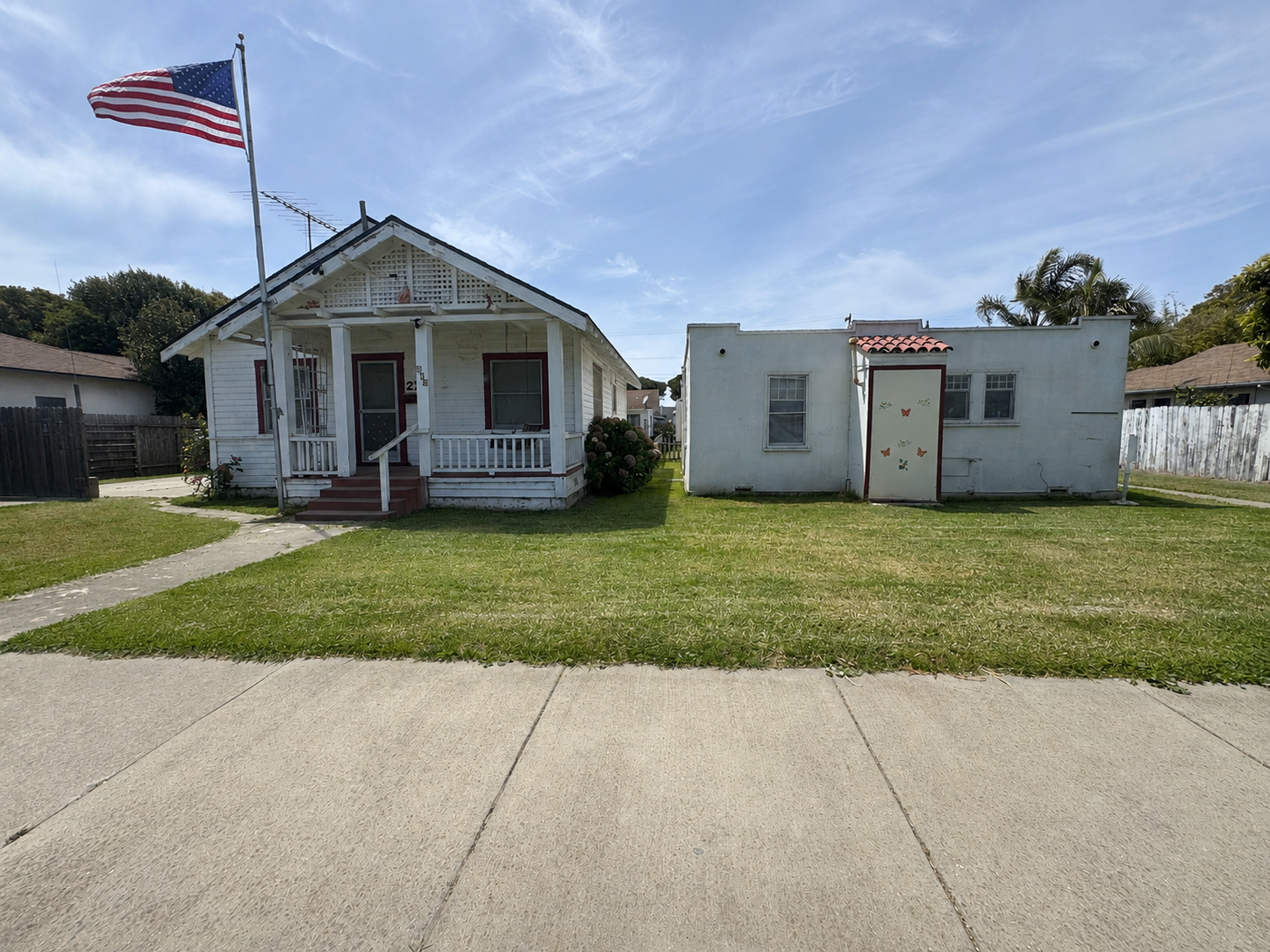
We have sold two properties to Quick Home Offers this year…
We have sold two properties to Quick Home Offers this year, dealing mostly with Adam Justiniano. Adam is very professional and made the entire process smooth both times.
Your Three Options: Keep, Renovate, Rent, or Sell
If you’ve inherited a house that needs work, there are three paths in front of you: renovate and keep it, rent it out, or sell the inherited property in its current condition. The right answer depends on the property’s condition, your financial situation, and how involved you want to be. None of these is automatically the best choice — what matters is whether the numbers actually work for your specific circumstances.
Keep the Property and Renovate – Option 1
Keeping an inherited house can make financial sense when the property is in a desirable area, you have cash to fund renovation projects, and you plan to either live in it or hold it as a long-term investment. If the home carries sentimental value — a childhood home, a family gathering place — that may factor into the decision as well.
But renovation costs on inherited homes are often higher than heirs expect. Properties owned by elderly family members typically come with years of deferred maintenance — aging roofs, outdated electrical panels, deteriorating plumbing, and HVAC systems past their useful life. If the home was built before 1978, there may be environmental hazards like lead paint or asbestos that require professional remediation before any remodeling work can begin. Foundation problems, water damage, and termite damage are also common in older California homes.
Before committing to renovations, get a professional property inspection. A licensed inspector can identify major structural problems, code issues, and hazards that aren’t visible during a walk-through. Cost overruns of 20% to 30% are expected on older inherited properties because problems hidden behind walls don’t show up until demolition starts.
If the repairs are mostly cosmetic — paint, flooring, fixtures, landscaping — the math may work in your favor. Low-cost improvements that have a high impact can often be more beneficial than full renovations. Common advice is to avoid major projects unless they will significantly increase the property’s value afterwards. If you’re looking at a new roof, foundation repair, full re-plumbing, or system replacements, you could be looking at $50,000 to $250,000 or more before the home is market-ready. Get written estimates from contractors before committing.
One financing option is a home equity loan against the inherited property, but that adds debt to an asset you may have just received free and clear. You might also consider low-interest loans, such as state or federal options, loans, or grants designed to help you fix up the home. If you plan to move into the home as your primary residence, an FHA 203(k) rehabilitation loan allows you to roll the purchase or refinance and renovation costs into a single mortgage — but it’s only available for owner-occupied properties, not rentals or investment holds. Talk to a financial advisor before borrowing against an inherited house — the repair costs need to be justified by a real increase in the property’s value, not just a hope that the market will cooperate.
Rent It Out – Option 2
Renting an inherited property can produce rental income, but the return on a paid-off California home is often lower than heirs assume — and the responsibilities are higher than most first-time landlords expect.
Here’s what a typical rental scenario looks like on a $600,000 inherited home renting at $3,000 per month in California:
- Annual rental income: $36,000
Estimated annual expenses:
- Property taxes (reassessed to current market value under Proposition 19): $6,600
- Landlord insurance coverage: $2,400
- Maintenance and repairs (1% of the property’s value): $6,000
- Vacancy (roughly 18 days per year): $1,800
- Capital reserves for major replacements (roof, HVAC, water heater): $3,000
- Property management fees (8–10% of rent, if you hire a manager): $3,600
Total annual expenses: approximately $19,800 if self-managed, or $23,400 with a property manager.
Net annual income before income taxes: roughly $16,200 self-managed, or $12,600 with a property manager.
On $600,000 in equity, that works out to a 2.1% to 2.7% annual return before income taxes. After federal and California state income taxes on the rental income, the after-tax return drops to roughly 1.6% to 2.0%.
That doesn’t mean renting is the wrong decision. The property may also appreciate over time, and rental income potential can improve if rents rise in your local market. But run the actual numbers for your specific property before assuming a paid-off house is a strong investment. The monthly cash flow can sound appealing until you subtract property taxes, insurance coverage, vacancy, maintenance, and the occasional $2,000 water heater or $18,000 – $25,000 roof repair that wipes out months (or years) of rental income.
If you’re an out-of-state heir, property management fees reduce returns further — and you’re still responsible for major decisions, emergency repairs, and tenant issues from a distance. California’s landlord-tenant laws are among the most complex in the country. Talk to a tax professional or certified financial planner before committing, because the rental income is taxable as ordinary income and could affect your overall financial situation more than you expect.
Sell the Inherited Property As-Is – Option 3
Selling an inherited house as-is — without making repairs — is the fastest path to closing. Selling the inherited house as-is can be the quickest option, especially if the property requires significant repairs, but it may result in a lower sale price compared to a renovated home. You avoid renovation costs, carrying costs, and the financial burden of maintaining a property you don’t want or can’t manage.
There are two ways to sell as-is: list with a real estate agent, or sell directly to a cash buyer.
Listing with an agent typically produces a higher sale price, but selling costs add up. Agent commissions run 5% to 6%, and total costs, including staging, photography, and closing fees, can reach 8% to 10% of the sale price. If the property needs significant work, most buyers relying on conventional financing can’t close, which limits your pool of potential buyers to cash buyers and investors, regardless of how you list it.
The number that matters is net proceeds — what you walk away with after all costs, not the listing price.
On a $600,000 inherited property, commissions, closing costs, carrying costs during the sale, and any repairs you made to get it listed can easily total $60,000 to $80,000. A cash offer skips all of that. No commissions, no repairs, no months of property taxes and insurance while you wait for financing to clear. The offer is lower on paper, but the gap between the two net numbers is often much smaller than the gap between the two headline prices. When the property needs significant work or probate is dragging, the cash sale sometimes nets more because carrying costs never had a chance to pile up.
When selling an inherited property, heirs are legally required to disclose all known defects, including structural concerns and past water damage, as required by state laws. The average time to sell a house is approximately 55 days, but this can vary based on the property’s condition and local market conditions.
Selling the inherited property is the best path for heirs who cannot afford the mortgage, and when it does not make sense to rent.
Neither path is automatically right. If the house is in good condition, all heirs agree, and you have time, listing in a strong seller’s market will probably net more. If the property has major issues, the timeline is tight, or holding costs are mounting, selling as-is to a cash buyer may produce a better outcome when all costs are factored in.
If There’s a Reverse Mortgage, This Is Urgent
A reverse mortgage doesn’t go away when the borrower dies. Most reverse mortgages today are Home Equity Conversion Mortgages — HECMs — insured by the Federal Housing Administration. According to the Consumer Financial Protection Bureau, once heirs receive a due and payable notice from the lender, they have 30 days to buy, sell, or turn the home over to the lender. There is the possibility of extensions up to six months for heirs actively working toward a sale. Note that other reverse mortgage products exist, such as proprietary jumbo reverse mortgages, which may have different terms. Talk with the loan servicer to be sure.
Your options as an heir:
- Pay off the loan balance and keep the property
- Sell the property and use the proceeds to pay off the loan — keeping whatever remains
- If the balance exceeds the home’s value, HUD’s guidance allows you to sell for at least 95% of the current appraised value, and the lender must accept that as full satisfaction — FHA insurance covers the rest
- Deed the property back to the lender and walk away owing nothing
We’ve purchased California homes with active reverse mortgages in Sacramento, Palm Springs, and elsewhere across the state. In practice, a reverse mortgage sale works like any other transaction once everyone understands the timeline — the servicer gets paid at closing, escrow handles the mechanics.
The worst thing you can do when a reverse mortgage is involved is nothing. Contact the servicer immediately, document that you’re actively working toward resolution, and protect your right to those extensions from day one.
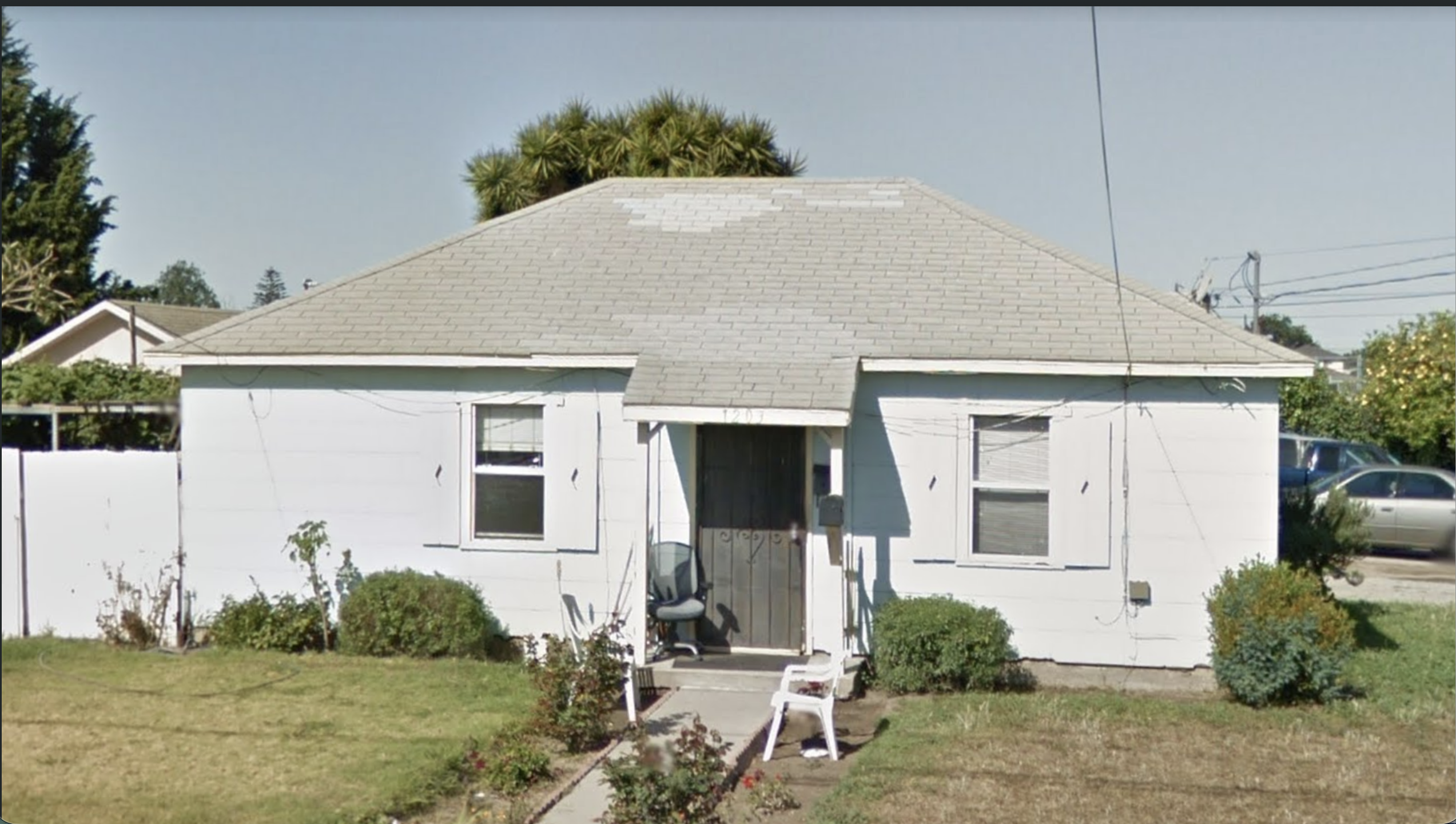
I could not of picked a better company to work with
“They were wonderful to work with i could not of picked a better company to work with. I live in Idaho so it was a long distant sell and Adam helped us so much he was always keeping me informed of what was going on, he even helped me with getting my tenants out and also helping my tenants relocate. I would use them again in a heart beat.”
Enter your number. We’ll walk through your options — whether you sell to us or not. No fees. No obligation. Serving California since 2013.
Trusts, Trustees, and What the Role Actually Requires
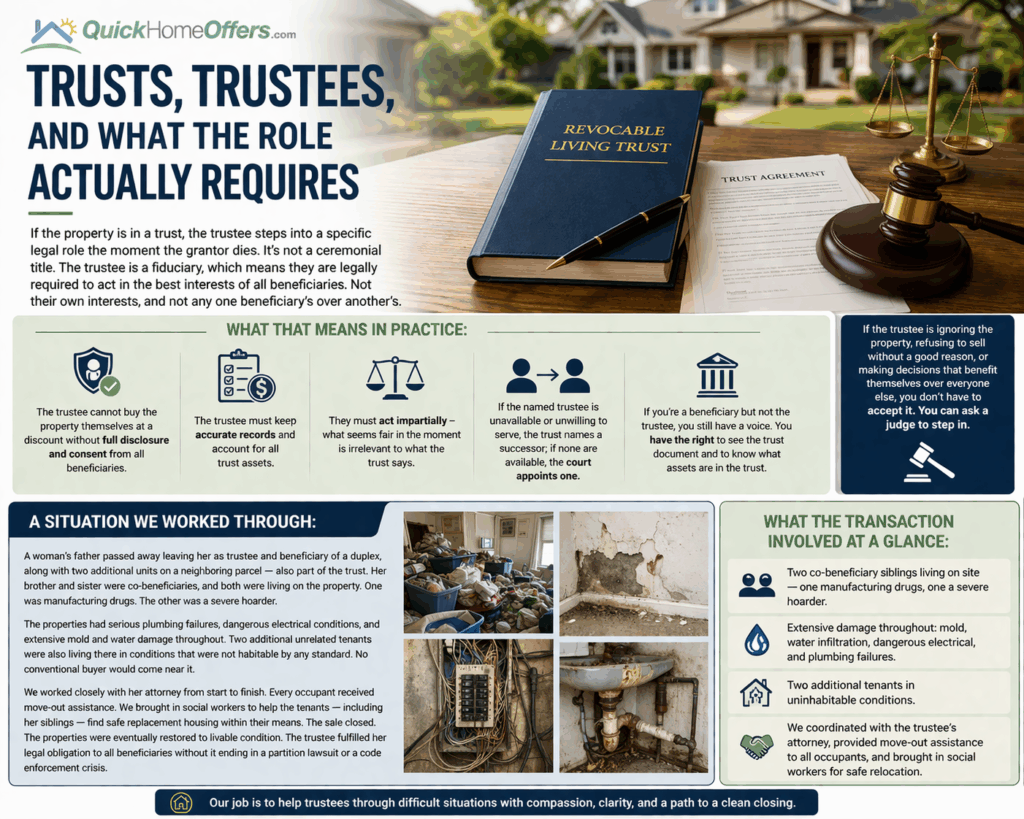
If the property is in a trust, the trustee steps into a specific legal role the moment the grantor dies. It’s not a ceremonial title. The trustee is a fiduciary, which means they are legally required to act in the best interests of all beneficiaries. Not their own interests, and not any one beneficiary’s over another’s.
This is especially important when the inherited property needs work — the trustee can’t let a property deteriorate while delaying a decision, because that deferred maintenance reduces the value for all beneficiaries. The trustee has a duty to safeguard this valuable asset and ensure its value is preserved for the benefit of all heirs.
What that means in practice:
- The trustee cannot buy the property themselves at a discount without full disclosure and consent from all beneficiaries.
- If the named trustee is unavailable or unwilling to serve, the trust names a successor; if none are available, the court appoints one.
If you’re a beneficiary but not the trustee, you still have a voice. You have the right to see the trust document and to know what assets are in the trust. If the trustee is ignoring the property, refusing to sell without a good reason, or making decisions that benefit themselves over everyone else, you don’t have to accept it. You can ask a judge to step in.
Case Study: Selling an Inherited House Held in a Trust
The summary below lays out what made this sale complicated and how it came together. Most trust sales aren’t this severe, but the same approach applies when a property is occupied, in poor condition, and several beneficiaries are involved.
- Situation
- Inherited multifamily property held in trust; the seller was both trustee and a beneficiary.
- Challenge
- Co-beneficiaries and unrelated occupants living on site, severe disrepair, and real health and safety hazards.
- What we did
- Worked with the trustee’s attorney, arranged move-out help and social-worker support for every occupant, and bought the property as-is.
- Timeline
- Closed on the seller’s requested timeline.
- Outcome
- The sale closed, occupants were safely rehoused, and the property was restored. No partition lawsuit, no code enforcement action.
More often than not, the trust situations that turn complicated share a pattern. The property has fallen into bad shape, and the people still living in it are part of the family.
In one situation, a seller’s immediate family member passed away, leaving them as trustee and beneficiary of multiple inherited multifamily properties the family had owned for years. The seller’s siblings were co-beneficiaries, and both were living on the property. One of them was a hoarder. Other unrelated occupants were also living there in conditions that were not habitable by any standard. The property had serious plumbing failures, dangerous electrical conditions, and extensive mold and water damage throughout.
Hoarder homes present unique challenges, as the clutter can hide significant structural issues and create health risks, requiring extensive cleanup and repairs before any renovation can begin. No conventional buyer would come near it.
We worked closely with the seller’s attorney from start to finish. Every occupant received move-out assistance, and we brought in social workers to help all of them find safe replacement housing within their means. The sale closed on the seller’s requested timeline. The property was eventually restored to livable condition. The trustee met their legal obligation to all beneficiaries without it ending in a partition lawsuit, a code enforcement crisis, or worse.
What Happens to the Debts on an Inherited Property?
The short answer: secured debts follow the property; unsecured debts generally don’t. Anything recorded against the property as a lien — unpaid property taxes, mortgage balances, HOA liens, mechanics liens, recorded judgment liens — stays with the property when ownership transfers. These must be resolved at closing, but in most cases, they’re paid from the sale proceeds. You typically don’t need to come out of pocket before the transaction funds.
Credit card balances, medical bills, and personal loans are a different story. Those are claims against the estate, not the property itself. The heir who receives the house does not personally inherit that debt. Heirs should consult with a tax professional or financial advisor to understand which debts are the estate’s responsibility and which, if any, could affect their personal financial situation. Additionally, depending on the estate’s value and how assets are transferred, federal taxes such as federal estate taxes and gift taxes may apply, so it’s important to consider these potential tax implications when inheriting a house that needs work.
We’ve closed on California properties carrying more than 5 years of delinquent property taxes across multiple Los Angeles County parcels. In every case, those balances were resolved through escrow — the sellers walked away with their net proceeds without funding anything upfront. On a separate transaction, a consumer debt judgment had been recorded against the property before the owner passed. We worked with the seller’s attorney to negotiate that balance down before closing, which allowed the sale to proceed cleanly.
Before anything else, ask a title company to pull a preliminary title report. It shows every recorded lien, takes a few days, and most title companies will do it at no cost when there’s a realistic chance of a transaction. It removes all the guesswork about what you’re actually dealing with.
What a Vacant Inherited Property Actually Costs Every Month
Every month, an inherited property sits empty, and the costs compound. These are real, recurring expenses that stack up quietly in the background while probate moves slowly or heirs work through disagreements. It’s crucial to account for all ongoing costs, including insurance costs, when evaluating whether keeping or selling the property aligns with your financial goals. Changing locks and updating insurance are key initial steps to protect the property and prevent further damage.
| Monthly Cost | Estimated Range |
|---|---|
| Property taxes | $400–$800 |
| Vacant property insurance | $150–$400 |
| Utilities | $50–$200 |
| Basic maintenance | $100–$300 |
| Total monthly baseline | $750–$1,700 |
Over a 12-month probate timeline, that’s $9,000 to $20,000 in carrying costs before you account for emergency repairs, code violations, or deferred maintenance that worsens while the property sits. Many inherited homes also have outdated electrical systems, aging plumbing, or roofing that no longer meets current safety codes — problems that get worse and more expensive the longer the property sits vacant. If the home was built before 1978, there’s also the risk of lead paint exposure or asbestos, which can create liability for the estate and may require professional remediation before sale.
Beyond the money, a vacant property creates liability that falls directly on the trustee or executor:
- Standard homeowner’s insurance policies typically exclude coverage after 30 to 60 days of vacancy — if a pipe bursts or a fire starts, the claim may be denied.
- Code violations accumulate from overgrown landscaping, pest infestation, or structural deterioration — fines become liens
- Unauthorized occupants, squatters, or tenants who are not paying are harder to remove the longer they’ve been there — a formal unlawful detainer action in California typically runs several thousand dollars and can take months or longer to complete.
- Slip-and-fall or injury on an unmaintained property can generate a negligence claim against the estate
None of this is meant to rush a decision. It’s meant to ensure heirs make an informed one. A sale that nets $20,000 less than retail may still produce a better outcome when you factor in a year of carrying costs, a code violation or two, and a full probate timeline.
When Multiple Heirs Can’t Agree
More inherited property sales stall here than anywhere else. Clean title, no serious debt, a ready buyer — and the whole thing goes sideways because the heirs can’t get to a decision together.
The legal structure matters:
| Ownership Type | Who Can Sell | What Happens If Someone Refuses |
|---|---|---|
| Property in a trust | Trustee, no unanimous consent needed | Beneficiaries can petition the court if the trustee is acting improperly |
| Probate estate | Court-appointed executor | Heirs can petition the court if the executor is acting improperly |
| Tenants in common | All owners must agree | Any co-owner can file a partition action to compel a sale |
If the property was inherited as tenants in common (which is common when there’s no trust and multiple heirs are named), every owner must agree to a voluntary sale. A single heir can block the transaction indefinitely. When that happens, the other co-owners can file a partition action in a California court to compel a sale. It’s slow, expensive, and hard on family relationships. Most situations settle before it gets that far — but sometimes just raising the option is enough to break the stalemate.
The real obstacles in multi-heir situations are rarely legal. They’re logistical and emotional. Heirs live in different states or different countries. They have different financial pressures and different histories with the property. Getting everyone to the same place takes longer than the legal steps ever do.
The Real Cost of Going Through Probate in California

Probate in California is slow and expensive by design. Fees are set by statute and calculated on the gross value of the estate — not the equity, not what’s left after the mortgage. A property worth $600,000 with a $300,000 mortgage is treated as a $600,000 estate for fee calculation purposes. Determining the property’s value at the time of inheritance is also important for tax purposes, such as calculating future capital gains taxes.
Attorney fees are set by California Probate Code § 10810, and the executor receives identical compensation under § 10800. It’s wise to consult financial professionals to fully understand the financial impact of probate, including legal, tax, and estate considerations.
Statutory fee breakdown on a $600,000 estate:
| Estate Value (gross) | Rate | Fees |
|---|---|---|
| First $100,000 | 4% | $4,000 |
| Next $100,000 | 3% | $3,000 |
| Remaining $400,000 | 2% | $8,000 |
| Attorney’s fee (one statutory fee) | $15,000 | |
| Combined fees (attorney + executor, each paid the same) | $30,000 |
Statutory probate fees are set by California Probate Code §10810 and §10800. The attorney and the executor are each paid the same statutory fee, so the estate pays it twice. Fees are based on the gross value of the property, not your equity, so a mortgage does not reduce them.
That’s before court filing fees, newspaper publication costs, appraisal fees, or any extraordinary fees the court approves under Probate Code § 10811 for unusual circumstances. And it’s before a single month of carrying costs on the property itself.
The California Courts formal probate overview confirms the full process typically takes 9 to 18 months and can run longer for contested estates.
A few things worth knowing:
- An executor granted authority under the Independent Administration of Estates Act — Probate Code § 10400 can often sell property without a court confirmation hearing, which reduces the timeline meaningfully
- Property taxes, insurance, and maintenance continue to accrue throughout the entire probate period
- The court can award extraordinary fees above the statutory amounts — ask your attorney upfront whether your situation is likely to trigger them
What the IAEA can do for you — and what it can’t:
The Independent Administration of Estates Act — Probate Code §§ 10400–10592 is the single biggest timeline lever available in a California probate. It’s worth understanding in plain terms.
When the court grants IAEA authority, the executor can list and sell property without a separate court confirmation hearing. The sale still requires a 15-day Notice of Proposed Action to all beneficiaries, but if no one objects, the transaction closes without further court involvement.
Full IAEA authority must be specifically requested — typically when the initial Petition for Probate is filed. The decedent can also prohibit it in their will. If the estate includes real property, ask your probate attorney about IAEA authority on day one. It’s the difference between a sale that takes months of court scheduling and one that moves like a normal real estate transaction.
One significant tax advantage that heirs often overlook
According to the IRS, the basis of inherited property is generally the fair market value at the date of the decedent’s death. This stepped-up basis provides significant tax advantages, as it typically resets the property’s cost basis to its current market value, which can greatly reduce capital gains taxes if you sell the property later.
As a result, if you sell shortly after inheriting, you typically owe no capital gains tax on appreciation that occurred during the prior owner’s lifetime, effectively reducing capital gains tax liability. If you hold the property and it appreciates further, you owe gains only on the increase above that stepped-up value. Talk to a CPA before making any decisions based on this — every situation is different. A certified financial planner or tax professional can also help you understand the broader tax implications, including how inheritance taxes, income taxes on rental income, and California’s Proposition 19 reassessment interact with your specific financial situation.
When a Cash Sale Makes Sense
A cash buyer isn’t the right answer for every inherited property. If the house is in good condition, probate is closed, all heirs are aligned, and you have time, a traditional listing will likely net more money. We’ll tell you that directly.
But many inherited properties don’t fit that description. Here’s an honest side-by-side:
| Factor | Sell as-is to a cash buyer | Renovate, then list with an agent |
|---|---|---|
| Time to close | About 10–21 days | About 2 to 9+ months, depending on the scope of the work |
| Upfront costs to you | None — no repairs, cleanout, or staging | Mortgage, property taxes, insurance, utilities, permits and construction, and staging — carried until the home sells |
| Who handles repairs and cleanout | The buyer takes the home in its current condition | You or the estate, before the home can be shown |
| Effort if heirs are remote or dispersed | Minimal — the sale can close fully remotely | High — managing contractors and showings from a distance |
| Sale price | Typically lower, reflecting the home’s as-is condition | Likely higher than a cash sale |
| Net proceeds | Predictable and easy to calculate — no closing costs, commissions, or repairs, and lower holding costs add to your bottom line | Can exceed a cash sale when the project is managed well, the repairs are the right ones, and the market holds steady |
| Best fit | The home needs real work, you need speed or certainty, or the heirs live out of the area | Sellers focused on maximizing sale price who have project-management experience, where the heirs are aligned on the plan and market risk is low; homes needing only cosmetic updates can fit here too |
At Quick Home Offers, Adam and Josh Justiniano personally evaluate every property. No algorithms, no automated offers — one of us looks at what you have and gives you a straight number. We’ve been doing this since 2013 across more than 300 California transactions. We’ve handled delinquent taxes, recorded judgment liens, active reverse mortgage deadlines, uninhabitable properties, and multi-heir sales with heirs on two different continents.
If you want to know what we’d pay, call us at 805-870-5749 or submit the address below. No obligation.
If you’ve inherited a property in California and aren’t sure what to do next, we’re happy to talk it through.
Call Adam Justiniano at (805) 870-5749 — no obligation, no pressure, just a conversation about your options.
Enter your number. We’ll walk through your options — whether you sell to us or not. No fees. No obligation. Serving California since 2013.
We have sold two properties to Quick Home Offers this year…
We have sold two properties to Quick Home Offers this year, dealing mostly with Adam Justiniano. Adam is very professional and made the entire process smooth both times.
Frequently Asked Questions About Inheriting A Home That Needs Repairs In California
Q: Do I have to go through probate to sell an inherited house in California?
A: Not always. If the property was held in a living trust, the trustee can sell without probate. If it were held in joint tenancy, title passes automatically to the surviving co-owner. Probate is required when the property was held solely in the deceased’s name and the total estate value exceeds $208,850 — though a 2025 law change allows a simplified transfer process for primary residences valued at $750,000 or less.
Q: How long does California probate take?
A: Typically 9 to 18 months, sometimes longer for contested estates. An executor with full IAEA authority can sell property without a court confirmation hearing, which shortens the timeline. See the probate section above for the full fee breakdown.
Q: What happens to a reverse mortgage when someone dies?
A: According to the Consumer Financial Protection Bureau, heirs receive a due and payable notice and have 30 days to act, with extensions available up to six months for heirs actively working toward a sale.
Q: Will I owe capital gains tax when I sell an inherited house in California?
A: Generally, no, if you sell shortly after inheriting. According to the IRS, the basis of inherited property is stepped up to fair market value at the date of death. If you sell at or near that value, there is typically no taxable gain. If you hold the property and it appreciates before selling, you owe gains only on the increase above that stepped-up basis. Talk to a CPA — every situation is different.
Q: How does Proposition 19 affect an inherited property in California?
A: Proposition 19, effective February 2021, significantly changed the property tax rules for inherited homes. Unless the heir moves into the property as their primary residence within one year, the property is reassessed to the current market value, which can substantially increase annual property taxes. If you inherit a home your parents bought decades ago at a low assessed value, and you don’t plan to live there, expect a meaningful tax increase. The California State Board of Equalization has guidance on how the reassessment rules apply.
Q: Can one heir force a sale if the others won’t agree?
A: Yes. If the property is held as tenants in common and an heir refuses to sell, any co-owner can file a partition action in a California court to compel a sale. Partition actions are slow and expensive — most families reach an agreement before it reaches that point. If you’re in this situation, consulting a probate attorney about partition as an option — without necessarily filing — is often enough to move negotiations forward.
Q: What if the inherited property has liens or years of unpaid taxes?
A: Liens and delinquent property taxes follow the property and must be resolved at the close of escrow. In most cases, they’re paid from the sale proceeds. You typically don’t need to come out of pocket before the transaction funds. We’ve closed on California properties with years of delinquent property taxes across multiple parcels. In every case, those balances were resolved through escrow.
Q: Can I sell an inherited house as-is without making repairs?
A: Yes. Cash buyers purchase properties in any condition. If the property can’t qualify for conventional financing due to its condition — issues like roof damage, foundation problems, or failing to meet HUD’s minimum property standards — your buyer pool is limited to cash buyers and investors, whether you list with an agent or not. The difference is whether you’re paying 5% to 6% in commissions to reach the same pool of buyers you could contact directly.
Q: What if I live out of state or overseas?
A: Distance is not an obstacle. Signing, identity verification, and receiving proceeds can all be handled remotely through a title company and escrow. We’ve closed on California inherited properties with heirs in other states and other countries — the process works the same way regardless of where you are.
Q: What is IAEA authority, and should I ask for it?
A: The Independent Administration of Estates Act — California Probate Code § 10400 allows an executor to manage and sell estate property without going back to court for approval on every transaction. With full IAEA authority, a property can be listed and sold almost like a standard real estate transaction, without a court confirmation hearing. It must be specifically requested — typically when the initial Petition for Probate is filed. If the estate includes real property, ask your probate attorney about IAEA authority on day one.
About the Authors and Quick Home Offers®

Adam Justiniano is co-owner of Quick Home Offers® and works directly with sellers across California. He visits properties, meets with homeowners, and walks them through their options. Adam has been buying real estate since 2013 and has handled inherited properties involving probate, trust sales, reverse mortgages, liens, sibling disputes, and homes in serious disrepair. He grew up in Ventura County and still lives there today.

Josh Justiniano is co-owner of Quick Home Offers® and runs the company’s underwriting, financial analysis, and project management. He evaluates the numbers behind every offer the company makes and manages renovation projects on properties they acquire. Josh worked at a legal firm in Thousand Oaks before entering real estate at 21, which gave him an eye for detail that carries into every transaction. He attended California State University of Northridge and majored in real estate. He and Adam have closed over 300 property transactions across California since 2013.
Quick Home Offers® is a California cash home buying company headquartered in Thousand Oaks, CA. The company purchases houses, condos, multifamily properties, and land statewide. Every offer is personally evaluated by Adam or Josh, not generated by an algorithm. To speak with them directly, call (805) 870-5749.
If you’ve inherited a property in California and aren’t sure what to do next, we’re happy to talk it through.
Call Adam Justiniano at (805) 870-5749 — no obligation, no pressure, just a conversation about your options.