

If you have a tax lien on your property in California, ignoring it will not make it disappear. The lien stays attached to your title, the debt grows with penalties under California Revenue and Taxation Code, and the consequences get worse the longer you wait. But there is one thing most people get wrong about tax liens: having one does not mean you are stuck. You can still sell your property. The lien is usually paid through escrow at closing, whether it’s a county property tax lien, a California Franchise Tax Board lien, or an IRS federal tax lien. If you’re also facing foreclosure in California and want to sell, see our in depth guide.
At Quick Home Offers®, roughly one in four properties we purchase has some kind of lien on title. Tax liens are among the most common. Adam and Josh Justiniano have been handling these transactions across California since 2013, and in nearly every case, the lien is resolved through escrow without the seller paying anything out of pocket before closing.
Quick Answer: Tax Liens on California Property
A tax lien is a legal claim the government places on your property when you owe unpaid taxes. It does not mean your home is being seized, but it does prevent you from selling, refinancing, or transferring the property until the lien is resolved. California homeowners may face three types: county property tax liens, California Franchise Tax Board liens for unpaid state income taxes, and IRS federal tax liens for unpaid federal taxes. If a property tax lien goes unresolved for five years, the county can sell the property at a public tax auction. FTB and IRS liens each last 10 years and can affect your credit. You can resolve a tax lien by paying it directly, setting up an installment plan, or selling the property. In most cases, the lien is paid through escrow from the sale proceeds at closing. The buyer receives a clean title, and the seller walks away without the debt.
This guide covers property tax liens, California Franchise Tax Board (FTB) liens, and IRS federal tax liens. We explain what happens when you ignore each type, how they actually get resolved, and what your options are if you are dealing with one right now.
What Is a Tax Lien?
A tax lien is a legal claim the government places on your property when you owe unpaid taxes. It does not mean the government is taking your home. It means they have secured their interest in your property, so the debt gets paid before your title can transfer to a new owner.
Tax liens get recorded with your county recorder’s office and show up on any title search. That means they will surface the moment you try to sell, refinance, or transfer the property. Until the lien is satisfied, your title is not clear. There are three main types of tax liens California homeowners run into, and each one works differently.
Property Tax Liens in California
When you fall behind on property taxes, the county automatically places a lien on your property. You do not receive a separate notice about the lien itself because it happens by operation of law. The moment your property taxes become delinquent, the lien exists.
Most homeowners with a mortgage have their regular property taxes paid through an escrow impound account. But not every property tax bill goes through that account. Supplemental tax bills, escape assessments, and Mello-Roos or special bond assessments are billed separately and sent directly to the homeowner. If you do not realize these bills exist, they go unpaid, and the county treats them the same as any other delinquent property tax.
Supplemental taxes are triggered when a property changes ownership, such as through an inheritance or new construction is completed. The county reassesses the property and sends a separate bill for the difference between the old and new assessed value, prorated for the remainder of the tax year.
Escape assessments happen when the county discovers property was under-assessed in a prior year and issues a corrected bill.
Mello-Roos and bond assessments are voter-approved charges tied to community facilities districts and show up as separate line items that are not always captured by a mortgage servicer’s impound account.
We see this regularly. A homeowner finds out they have a delinquent tax balance they never knew about because the bill went to the wrong address, or they assumed their mortgage company was handling it. By the time they discover it, penalties have been accruing.
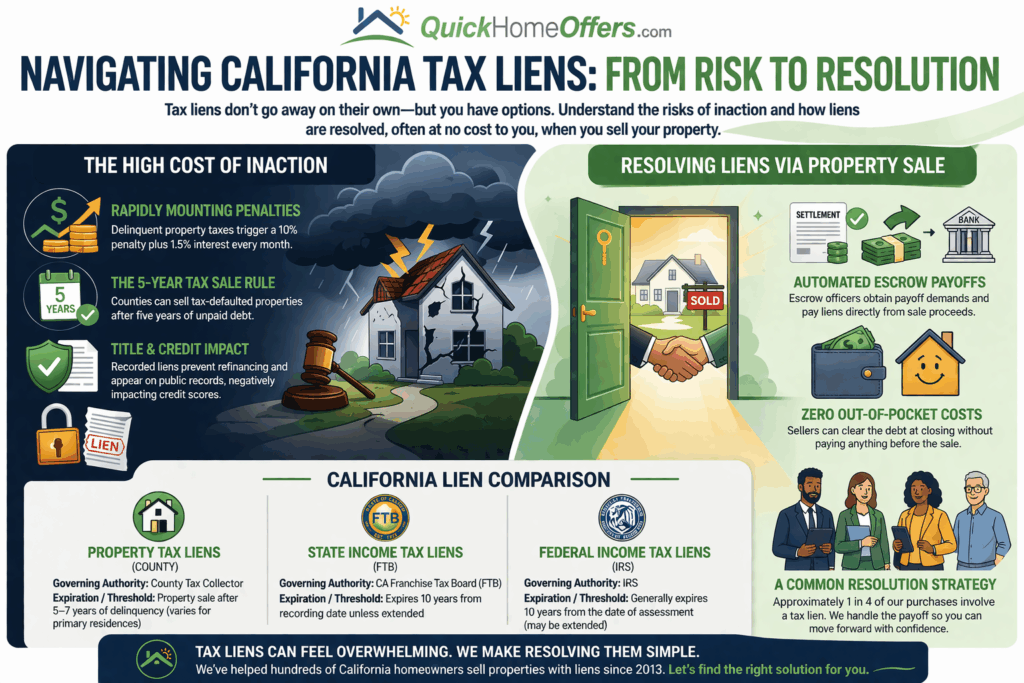
Here is what happens if you let it sit. California charges a 10% penalty on delinquent property taxes, plus 1.5% per month in additional penalties after certain deadlines. Those costs add up fast. If property taxes remain unpaid for five years, the county can sell your property at a tax sale to recover the debt. Under California Revenue and Taxation Code §3691, the tax collector must attempt to sell tax-defaulted property that has been delinquent for five or more years. For property used as a primary residence, the redemption period can extend to seven years in some circumstances.
This is not a theoretical risk. Counties across California conduct tax-defaulted property auctions regularly. But here is the reality: most homeowners resolve the issue long before it gets to that point, often by selling the property and paying the tax debt through escrow.
California Franchise Tax Board (FTB) Liens
If you owe unpaid state income taxes, the California Franchise Tax Board can record a Notice of State Tax Lien against your property. According to the FTB, when you owe a tax debt, they automatically have a statutory lien that attaches to all California real and personal property you own. If you do not respond to their letters, pay in full, or set up a payment plan, they will record the lien publicly.
Once an FTB lien is recorded, it shows up on title searches and can appear on your credit report. It stays in effect for 10 years from the date of recording unless the FTB extends it.
Here is what most people do not know: if you are selling your property, the FTB has a process specifically designed to handle lien payoffs through escrow. Your escrow or title company submits a payoff request through the FTB’s eDemand system. Once the FTB processes the request and receives payment from the sale proceeds, they release the lien. This is described directly on the FTB’s own website at ftb.ca.gov. If there is not enough equity in the property to cover the full lien amount, the FTB also has a process for insufficient funds in escrow and short sale situations.
IRS Federal Tax Liens
If you owe unpaid federal income taxes, the IRS can file a Notice of Federal Tax Lien. According to the IRS, this lien protects the government’s interest in all your property, including real estate, personal property, and financial assets. A federal tax lien attaches after the IRS assesses the tax, sends you a bill, and you neglect or refuse to pay. Once filed, the lien is public record and affects your ability to sell or refinance.
The IRS will release a federal tax lien within 30 days after you pay your tax debt in full. If you cannot pay in full, the IRS offers options, including installment agreements and offers in compromise. In a property sale, the IRS lien can be paid from the sale proceeds through escrow, just like state and county tax liens.
Can You Sell a House With a Tax Lien in California?
Yes. This is one of the most common misunderstandings we encounter. Sellers call us convinced they cannot sell their home because of a tax lien. That is not how it works. When you sell a property with a tax lien, the escrow company identifies the lien during the title search, obtains a payoff demand from the taxing authority, and pays the lien directly from the sale proceeds at closing. The lien is released, the buyer receives clean title, and the seller walks away without the debt.
This is standard procedure; title companies and escrow officers handle tax lien payoffs every day across California. You do not need to pay off the lien before listing or accepting an offer. We have transacted over 300 properties across California since 2013. Roughly one in four of those transactions had some form of lien on title, including property tax liens, FTB liens, and IRS liens. In nearly every case, the lien was paid through escrow and the seller did not have to come out of pocket for it.
If you owe more in liens than the property is worth, that is a more complex situation and deserves further discussion with a tax attorney. However, in most cases where there is equity in the property, selling and clearing the lien through escrow is straightforward.
Dealing with tax liens and just want to sell as-is and be done?
Enter your info below for a free, no obligation, cash offer. We will tell you upfront if you will net more listing conventionally.
"*" indicates required fields
What Are Your Options With Tax Liens?
Pay the lien directly
If you can afford it, contact the taxing authority and pay the full amount. For property taxes, contact your county tax collector. For FTB liens, log in to MyFTB or call 916-845-4350. For IRS liens, contact the IRS directly or work with a tax professional. Once paid, the lien will be released.
Set up a payment plan
Both the FTB and IRS offer installment agreements. County tax collectors often allow partial payments on delinquent property taxes. A payment plan will not remove the lien immediately, but it prevents the situation from getting worse.
Sell the property
If you do not want to deal with the tax debt yourself, or if the debt is large enough that paying it out of pocket is not realistic, selling the property is a clean exit. The lien gets paid from the proceeds. You walk away without the debt. Oftentimes, this is a good choice if you cannot afford the lien – the fees and penalties will continue to add up, costing you more money over the long-run.
Other Types of Liens
Tax liens are one of several lien types that can attach to California property. Judgment liens, mechanic’s liens, HOA liens, child support liens, and code enforcement liens each follow different rules for how they are recorded, how long they last, and whether the amount can be negotiated down.
We cover every type — including what happens when the company that recorded a lien no longer exists — in our complete guide to selling a house with a lien in California. If you are dealing with any lien on a California property and want to talk through your options, call us at 805-870-5749.
Frequently Asked Questions
Can I sell my house if it has a tax lien?
Yes. The tax lien gets paid through escrow at closing. The escrow company pays the taxing authority directly from the sale proceeds, the lien is released, and the buyer receives clean title.
How do I find out if there is a tax lien on my property?
Contact your county recorder’s office, check the FTB’s MyFTB portal for state tax liens, or order a preliminary title report from a title company. A title report will show all recorded liens on your property.
How long before California can sell my property for unpaid property taxes?
Under California Revenue and Taxation Code §3691, the county can sell tax-defaulted property after five years of delinquency. For owner-occupied residences, the timeline may extend to seven years in some cases.
Do tax liens expire in California?
FTB state tax liens expire 10 years from the date of recording unless extended. IRS federal tax liens generally expire 10 years from the date of assessment. Property tax liens do not expire on their own — they remain until the taxes are paid or the property is sold at a tax sale.
Can I sell a rental property with a tax lien and tenants still living in it?
Yes. The tax lien gets paid through escrow at closing, the same way it would on a vacant property. But selling a tenant-occupied property with a lien through a conventional sale can be difficult. Most traditional buyers do not want to inherit an existing lease, and their lender may have requirements around occupancy that complicate the transaction. Adding a tax lien on top of a lease transfer makes an already narrow buyer pool even smaller. This is where a cash buyer makes the most sense.
We buy occupied rental properties regularly and are comfortable with tenants in place. The tenants do not need to move out for the sale to close. We handle the lien through escrow and take the lease as-is. If you are a landlord with a tax lien and want to sell without the hassle of vacating the property first, call us at 805-870-5749.
Will a tax lien affect my credit?
FTB liens are public record and may appear on your credit report. The FTB does not notify credit bureaus directly, but the bureaus can pick up the information from county recorder records. IRS liens can also impact your credit.
What is the difference between a tax lien and a tax levy?
A lien is a legal claim — it secures the government’s interest in your property. A levy is when the government actually seizes property to satisfy the debt. A lien does not mean anyone is taking your home. A levy does.
Can Quick Home Offers® buy my house if it has a tax lien?
Yes. We regularly purchase properties with property tax liens, FTB liens, and IRS liens. Approximately 1 in 4 purchases has had some type of lien on the property. The liens will always be identified during the title search and paid through escrow at closing. Call 805-870-5749 to discuss your situation. Here’s how our process works.
Dealing with tax liens and just want to sell as-is and be done?
Enter your info below for a free, no obligation, cash offer. We will tell you upfront if you will net more listing conventionally.
"*" indicates required fields
About the Authors

Adam Justiniano is co-owner of Quick Home Offers® and works directly with sellers across California. He personally visits properties, meets with homeowners, and walks them through their options. Adam has been buying real estate since 2013 and has handled properties with property tax liens, FTB liens, IRS liens, judgment liens, and mechanic’s liens. Roughly one in four properties the company purchases has some type of lien on title. He grew up in Ventura County and still lives there today.

Josh Justiniano is co-owner of Quick Home Offers® and runs the company’s underwriting, financial analysis, and project management. He evaluates the numbers behind every offer the company makes, including calculating net proceeds for sellers dealing with lien payoffs through escrow. Josh worked at a legal firm in Thousand Oaks before entering real estate at 21, which gave him an eye for the documentation and title work that lien transactions require. He went to California State University of Northridge and studied Real Estate. He and Adam have closed over 300 property purchases across California since 2013.
About Quick Home Offers®
Quick Home Offers® is a California cash home buying company founded in 2013 and headquartered in Thousand Oaks, CA. The company purchases houses, condos, multifamily properties, and land statewide. Every offer is personally evaluated by Adam or Josh, not generated by an algorithm. If you are dealing with a tax lien and want to explore selling, call us at (805) 870-5749 for a no-pressure conversation.
We are not attorneys, and this is not legal advice — for legal guidance on tax liens, consult a licensed California tax attorney or real estate attorney.