
How To Sell a House In California From Out of State
Selling a California house from out of state is a logistics problem more than a real estate problem. The selling process works the same whether you live in state or out of state. What changes is everything around it: who opens the door for inspections, who signs the closing documents, and who watches a vacant property in a real estate market you no longer follow.
California home sellers run into this every year. Some left for a new job and kept their current home as a rental. Others inherited a house they have never lived in. Either way, an out of state sale raises the same three questions: how do you sign, who handles the house, and what does California take out of your check.
Everything below comes from what Quick Home Offers has learned across 300+ California transactions since 2013, many of them from sellers who never set foot in the state during the sale.
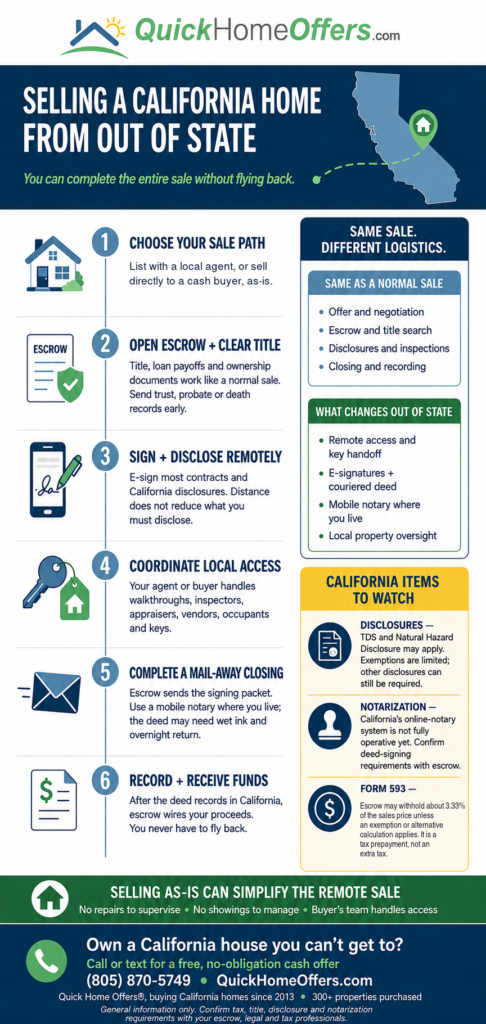
Can You Sell a California House Without Being There?
You can sell real estate in California without flying back, and usually within the same timeframe as an in-state sale. California law lets out-of-state sellers complete every step remotely: documents signed through a mail-away closing with a mobile notary in your state, a power of attorney if you prefer someone signs for you, and escrow handled by phone and email.
Your two main paths are hiring a local listing agent or selling directly to a statewide cash buyer like Quick Home Offers. Condition of the house and your time usually decide which one fits.
Three things still need a person on the ground: someone to let in inspectors and appraisers, someone to handle keys at the end, and someone to check on the property while it sits. With a listing agent, the agent covers most of it. In a direct sale, the buyer’s team handles access, which is why many out-of-state owners find selling a home that way simpler.
The sections below cover both paths and the three mechanics that make a remote sale work from a different state: the mail-away closing, the power of attorney, and California’s remote notarization rules.
Should You Hire a Listing Agent or Sell to a Cash Buyer?
The honest answer depends on the house, not on where you live. A listing agent usually nets more for a move-in ready house and costs you time and coordination. A cash buyer fits when the house needs work, because managing a remodel from another state is where remote sales fall apart.
A cash offer on a house that needs work does not automatically mean netting less. A list price is not a sales price, and a sales price is not what reaches your pocket. Realtor fees, holding costs, buyer concessions, repair credits, and insurance all come out before you see a dollar.
In Quick Home Offers’ underwriting on 300+ California transactions, the net proceeds from a cash sale sometimes beat the listed path once those costs are counted, especially on homes needing repairs the seller would have to fund and manage from out of state. Compare net proceeds, not list prices.
What Do Cash Real Estate Buyers Handle for Out – of – State Sellers?
A legitimate cash buyer handles everything that normally requires the seller in town. Access is the big one: the buyer’s team opens the house for its own walkthrough, meets any inspectors, and manages keys through closing, so nothing waits on you finding someone local. There are no showings to schedule, no repairs to fund or supervise, and no marketing period where the house sits empty and unwatched.
The purchase itself absorbs the property’s condition. A cash buyer purchases the house as-is, which means the leftover furniture, the deferred maintenance, and the projects you never finished all transfer with the sale. Take what you want and leave the rest. Every property Quick Home Offers has taken on since 2013, across more than 300 transactions, needed at least some work.
On the paperwork side, the buyer’s escrow runs the same process covered earlier: mail-away signing, electronic disclosures, and Form 593 withholding handled at the closing table. The selling process from your side compresses to reviewing the offer, signing remotely, and picking the closing date.
What Do Real Estate Agents Handle for Out-of-State Home Sellers?
A good agent works as your project manager on the ground. For out-of-state home sellers, real estate agents handle showings and lockbox access, meet inspectors, and coordinate the local vendors who get a house ready: cleaners, painters, landscaping for curb appeal, a stager if the house shows empty. Marketing runs without you there. Professional photos and virtual tours let potential buyers walk the house from their phone, which is when serious buyers appear.
Pricing is where distance hurts most, so ask for a comparative market analysis built on recent closed sales, not an online estimate and not your memory of the housing market from when you lived there. A top agent defends the right price with data and supervises vendor work personally; confirm both in writing, and ask about remote sales they closed in the past year. Local experts with a real system for absent sellers exist. Agents who plan to learn this process with your house also exist. The heavy lifting of a listed sale is coordination, and which kind of agent you hired decides how it goes.
Own a California Property You Don’t Want To Visit?
Tell us about the house and get a written cash offer. Compare it against any agent’s net sheet before you decide anything.
They were wonderful to work with!…
“They were wonderful to work with! I could not [have] picked a better company to work with. I live in Idaho, so it was a long distance sale and Adam helped us so much.”
Enter your number. We’ll walk through your options — whether you sell to us or not. No fees. No obligation. Serving California since 2013.
How Does a Remote Closing Work in California?
A remote closing is a standard California escrow where the seller signs everything from another state instead of at the escrow office. Most sales follow the same sequence. Escrow opens, the title company runs a title search, and the seller completes disclosures electronically. When it is time to sign, escrow prepares all the paperwork and sends it by overnight courier. You sign the notarized documents, including the grant deed, in front of a notary in your state. This is called a mail-away closing, and California escrow officers handle these real estate transactions every week.
The grant deed is the one document that almost always needs ink on paper. California county recorders expect an original, notarized deed, so that page travels by courier even when everything else is digital. The courier days happen inside the normal escrow period. Delays come from other places, like a title issue or waiting on a death certificate, and those hit local sellers just as hard.
What Disclosures Do Out-of-State Sellers Have to Make?
California sellers must disclose what they know about the property, and distance does not shrink the list. The two core forms are the Transfer Disclosure Statement, covering the property’s condition and defects, and the Natural Hazard Disclosure report, covering fire, flood, and earthquake zones.
Both are completed electronically, and the standard is what you actually know: material facts like a leaking roof, unpermitted work, or a neighbor dispute must be disclosed even if you have not seen the house in years. Guessing is not required; hiding is not allowed.
One exemption matters for out-of-state sellers specifically. Many trustees selling from a trust and court-supervised probate sales are exempt from the Transfer Disclosure Statement, because the seller never lived in the house and has no firsthand knowledge to disclose.
Other disclosures still apply, and a cash sale changes none of it: disclosure obligations run with the sale, not the buyer type. The full disclosure list and how as-is selling interacts with it are covered in our guide to selling a house as-is in California.
What Digital Tools Make a Remote Home Sale Easier?
Electronic signatures cover most of the closing documents in a California home sale. Purchase agreements, counter offers, escrow instructions, and the state’s required disclosure forms can all be signed from your phone. Real estate agents and escrow officers use secure document platforms as the default now, not the exception.
For an out of state sale, the practical toolkit is short: e-signature for the paperwork, a video call for the final walkthrough, and overnight courier for the notarized originals. None of it requires special arrangements. It only requires telling escrow up front that you are signing remotely, so the packet is built for it from day one.
Can You Notarize California Sale Documents Remotely?
Sometimes, and this is the one area where out-of-state sellers get wrong answers online. Three rules cover it.
First, California’s own notaries cannot notarize online yet. The Online Notarization Act (SB 696) was signed in September 2023, but the part that lets California notaries perform remote online notarization does not take effect until the Secretary of State finishes building the state’s system, with a deadline of January 1, 2030. Any California notary offering webcam notarization today is operating outside the law.
Second, California recognizes remote online notarization performed by notaries commissioned in states where it is legal. Under Civil Code section 1189, a notarization done under another state’s laws is valid in California. Since you live in another state, you may have legal access to online notarization that Californians do not.
Third, legal and accepted are not the same thing. The grant deed gets recorded with a California county recorder, and recorders and title companies set their own requirements for the deeds they accept. Many require a traditional wet-ink notarization on the deed. Ask your escrow officer before booking an online session.
The default that always works: a mobile notary comes to you, checks your driver’s license, and notarizes the courier packet in person. You never need to be physically present in California either way.
Do You Need a Power of Attorney to Sell From Out of State?
No. Most out-of-state sellers never use a power of attorney. The mail-away closing handles the signing problem by bringing the documents to you, so being in a different state is not by itself a reason to hand someone your signature.
A power of attorney earns its place in specific situations: you travel constantly and courier deadlines are a real risk, health makes signing sessions difficult, or several family members are selling an inherited house and want one person authorized to sign for the group.
If you use one, California has rules that matter. Use a limited power of attorney naming the specific property, not a general one. The document must be notarized, and when your agent signs a deed with it, the county recorder will require the power of attorney to be recorded along with the deed. Tell the title company early. Title officers review and approve the power of attorney before closing, and a form they see for the first time on signing day is the most common cause of a delayed remote closing we hear about from sellers who are now in a new state.
What Is Form 593 Withholding on a California Sale?
Form 593 is the Franchise Tax Board’s real estate withholding form, and it is the tax document most out-of-state sellers have never heard of until escrow mentions it. California requires withholding of 3 1/3 percent of the total sale price on most home sales unless the seller qualifies for an exemption. Withholding is not an extra tax. It is a prepayment of state income tax on the sale, credited back when you file your California return. If the withholding is more than you owe, the difference comes back to you.
Escrow handles the mechanics. The escrow company calculates the amount, collects it from your proceeds at closing, files Form 593, and sends the money to the Franchise Tax Board. You sign the form and keep a copy for tax time.
Who Is Exempt From Form 593 Withholding?
Common exemptions include a home that was your principal residence under federal tax rules, a sale at a loss or zero gain, a sale price of $100,000 or less, and certain 1031 exchanges. Here is the catch for out-of-state owners: the principal residence exemption is the most common one, and a house you moved away from years ago or inherited may no longer qualify.
Sellers can also elect withholding on the actual gain instead of 3 1/3 percent of the price, which often means less money held back. Run the numbers with a tax professional before closing. Withholding comes out of net proceeds at the same table as closing costs and agent commissions, so it belongs in your math when comparing offers, not as a surprise on the settlement statement.
A cash sale changes none of this. Form 593 works the same whether the buyer is financed or paying cash, and a legitimate cash buyer’s escrow handles it the same way any escrow does.
What If the House Has Tenants and You Live Out of State?
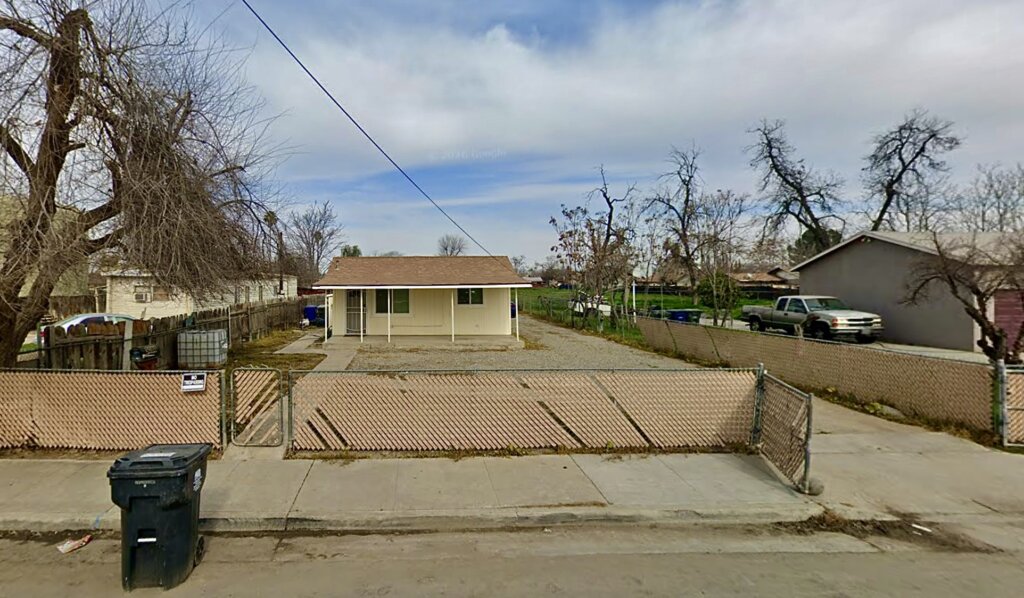
A tenant-occupied house can be sold from out of state, and the tenants do not need to leave first. California allows selling a home with a lease in place. The lease transfers to the buyer, who becomes the new landlord on the day escrow closes.
What changes for you is the paperwork: buyers will want a copy of the current lease, a rent roll showing what is paid and owed, and an estoppel certificate, which is a short form the tenant signs confirming the lease terms. Escrow requests these; your job is having them findable.
Distance makes the listing path harder here. California tenants are entitled to proper notice before showings, usually 24 hours in writing, and a tenant who feels ambushed can make every showing difficult from a distance. If the lease is month to month, if rent is behind, or if the occupant is a family member who stopped paying, coordinating that from another state is where most remote sales break down.
This is the situation where a direct sale does the most work. A cash buyer purchases with the tenants in place, handles the notice requirements, and takes over the landlord relationship at closing. Quick Home Offers has bought occupied homes in nearly every condition, including ones where the seller had never met the person living there. If the occupant is not a tenant at all and will not leave, that is a squatter situation with its own rules, covered in our guide to selling a house with squatters.
Selling an Inherited California House From Out of State
An inherited California house can be sold from out of state once you have legal authority to sell it, which depends on how the property passed to you. A house in a trust can usually be sold by the trustee right away. A house that must go through probate needs court authority first, and probate timelines, not distance, set the pace. Roughly 1 in 3 homes Quick Home Offers has purchased were inherited or in probate, and a large share of those sellers lived nowhere near the property.
Two details matter specifically for out-of-state heirs. First, escrow will need the death certificate and trust or court documents early, so gather them before listing anywhere.
Second, inherited homes often qualify for the Form 593 zero-gain exemption, because the tax basis resets to the value at the date of death, meaning little or no gain if you sell soon after. Everything else about inherited sales, from probate steps to selling with siblings, is covered in our full guide to selling an inherited house in California.
Which Sales Option Nets You the Most From Out of State?
| List with an agent | Sell as-is to a cash buyer | Do nothing for now | |
|---|---|---|---|
| Best for | Move-in ready house, no time pressure | House needs work, tenants in place, or estate sale | Nobody. Waiting has a monthly cost |
| Timeline | 30–60 days on market plus 30–45 days in escrow, typical | You pick the closing date | Open-ended |
| Repairs and prep | You fund and supervise from out of state | None, sold as-is | Deferred maintenance compounds |
| Who coordinates locally | Your agent, if you chose well | The buyer’s team | You, from another state |
| Costs that come out | Agent commissions, repairs, concessions, closing costs | Closing costs; no commissions, no repairs | Property taxes, insurance, upkeep, every month |
| Certainty | Depends on the buyer’s financing | Cash, no financing contingency | None |
| Likely net | Highest gross price, netted down by fees, repairs, and carrying costs | Lower gross price, few deductions, known number up front | Shrinks every month the house sits |
The honest read of the table: a move-in ready house with a strong local agent usually wins on net. A house that needs work, holds tenants, or sits inside an estate usually nets better in a direct cash sale once carrying costs and funded repairs are counted, and it closes without a single flight back. Run both numbers. An agent’s net sheet and a written cash offer are free, and together they turn this table into your actual answer.
If the house is move-in ready and you have a few months: list it with a local agent who has closed remote sales before. That is the case where the listed path earns its higher net.
If the house needs repairs you would have to fund and manage from another state: get a written cash offer before committing to a remodel. Remote renovations run over budget more often than local ones, and comparing the offer against a post-repair net sheet costs nothing.
If tenants live in the house: sell to a cash buyer with the lease in place, or resolve the tenancy before listing. Showing an occupied house from out of state is the most common point where remote listings sit on the market without offers.
If the house came through an estate: settle legal authority first, then choose the path. A trustee or court-authorized representative can sell remotely either way, and selling fast to one buyer often keeps a multi-heir sale simpler than a listing every heir must agree on.
Case Study: Inherited Ventura, CA Home Sold From 1,900 Miles Away
A family in the Midwest inherited a higher-end home in Ventura’s Ondulando neighborhood and contacted us first. They flew out once, early on, to see family and look at the house. Nothing about the sale required the trip, and nothing after it required another one.
We walked the property, made a written cash offer, and gave them one honest piece of advice: be careful about listing too high from out of state, because a vacant house you cannot check on is expensive to carry while you wait.
They listed anyway. An agent won the listing with an aggressive price, and the home sat vacant for six months without selling. From three states away, that meant six months of taxes, insurance, and utilities on a house nobody was watching, with every price conversation happening by phone.
They circled back. We honored the same offer we had made at the start and closed in about 21 days, with the signing handled where they lived. The high list price never became a high sale price. It became half a year of carrying a vacant home from 1,900 miles away.
Across 300+ California transactions since 2013, Quick Home Offers has seen that pattern most often with out-of-state sellers, because distance makes an overpriced listing slower to notice and more expensive to hold.
Don’t carry a vacant California house from another state.
Get the written offer first. List anyway if the numbers say to — but know your number before the holding costs start.
Enter your number. We’ll walk through your options — whether you sell to us or not. No fees. No obligation. Serving California since 2013.
Common Questions From Out-of-State Home Sellers
Do you need open houses or an agent to attract buyers from out of state?
No. Open houses and marketing only exist to find a buyer, and a direct sale skips the search entirely because the cash buyer is the buyer. If you do list, the agent runs showings and open houses without you there, and whether to hold one depends on the neighborhood and current market trends, not on where you live.
Who coordinates local vendors and repairs before the sale?
It depends on the path and the size of the work. In a direct cash sale, nobody has to: the house sells as-is, with cleaning, repairs, and leftover belongings included in the purchase. In a listed sale, an agent can coordinate small jobs like a paint refresh, a faucet repair, or a cleaning crew before photos.
Agents are not project managers, and finding one willing to run a full rehab is unlikely and not recommended. Even if you found one, trusting anyone to manage a large project from another state is a risk that rarely pays. When a house needs real work, the practical choices are two: fly back and run it yourself, or sell as-is to a buyer who prices the work in.
Can potential buyers tour the house if you are not there?
Yes. Quick Home Offers’ team will ask you for access to the home. If it’s vacant and you have no one in the state to open up, you can always mail a key directly to us, or we can have a locksmith open the door. A cash buyer’s team does its own walkthrough on a schedule you approve, with no lockbox on the door and no strangers through the house for weeks.
A listed sale means ongoing showings handled by the agent, plus virtual tours for out-of-area buyers, all without you present.
How long does it take to sell your house from out of state?
The same time as an in-state sale. Distance adds courier days inside escrow, not delay to the closing date. A direct cash sale closes on the date you pick; a listed sale runs on market time plus escrow. What actually stretches timelines are title issues and estate paperwork.
Do you pay California taxes when you sell from out of state?
Sometimes. California withholds 3 1/3 percent of the sale price through Form 593 unless you qualify for an exemption, and withholding is a prepayment of tax, not an extra tax. Any capital gains from the sale may still be taxable by California even after you move away. This works identically in a cash sale and a listed sale, and escrow handles the filing either way. A tax professional who handles multi-state returns is worth the fee the year your home sells.
How do agents set the list price from a new state?
You only need a list price if you list. A written cash offer replaces the pricing question with a number you can accept, counter, or decline. If you take the listing path, use a comparative market analysis built on recent closed sales, because whether that county is in a seller’s market or a buyer’s market is exactly what you cannot feel from a distance.
About the Authors and Quick Home Offers®
By Adam Justiniano, Co-Founder, Quick Home Offers® | Reviewed by Josh Justiniano | Updated August 2026

Adam and Josh Justiniano founded Quick Home Offers in 2013 and have closed more than 300 California transactions, from single-family houses and condos to multifamily and land. Adam works directly with every seller and has walked hundreds of properties in every condition across the state. Josh runs the underwriting and the numbers behind every offer, so every written offer reflects real repair costs and real market data, not a formula.
Real estate professionals across California know the company by its track record: honest offers, no pressure, and a successful sale for owners other buyers turn away. Many of those owners were hundreds or thousands of miles from the property when it sold. If you own a California house you cannot get to, call or text (805) 870-5749 and tell us about the property. A written offer costs nothing and takes a day to prepare, whether you sell your house to us or take it to market. Either way, the goal is the same: a smooth transition out of a property you no longer need, without a single flight back.
Get your offer without flying back.
Call or text (805) 870-5749, or drop your number below and Adam will reach out about your property.
Enter your number. We’ll walk through your options — whether you sell to us or not. No fees. No obligation. Serving California since 2013.