
Cash home buyers in California buy houses, condos, multifamily properties, and land directly from sellers. A typical cash sale closes in 7 to 30 days, with no repairs, no agent commissions, and no financing contingencies. If your property needs work, has title issues, or has problem tenants, a cash sale can net you as much as a traditional sale, or more. That is true once you count repairs, holding costs, agent fees, and escrow and title fees.
Cash sales are common in California at every price point, from entry-level homes to high-end properties. According to the National Association of Realtors, all-cash purchases reached an all-time high of 26% of all home sales in 2025.
Homes that need significant work or have title problems often take much longer to sell on the open market. This guide explains how a California cash sale works and how cash offers are calculated. It also covers what to watch out for and how to spot a buyer who will waste your time.
How Cash Home Buyers Work In California – Quick Answer
A cash home buyer usually makes a direct, no-obligation offer on your property based on its current condition and the local market. When selling to a direct buyer, a cash sale means there are no commissions, no lender requirements, and no repairs needed before closing. In California, sellers are still legally required to complete a Transfer Disclosure Statement even in a cash sale. Most Quick Home Offers® sales close in 7 to 30 days. Sellers can choose a longer timeline if they need one. Quick Home Offers® also helps with moving costs and clearing out personal items. In some cases, we advance cash to sellers before closing.
Get a no-obligation, competitive cash offer from one of California’s most experienced and trusted cash buyers. Quick Home Offers® has closed over 300 transactions since 2013.
"*" indicates required fields
For a competitive cash offer, call or text (805) 870-5749 or submit your address on this page. You can get an offer from Quick Home Offers® today.
What Is A Cash Home Buyer?
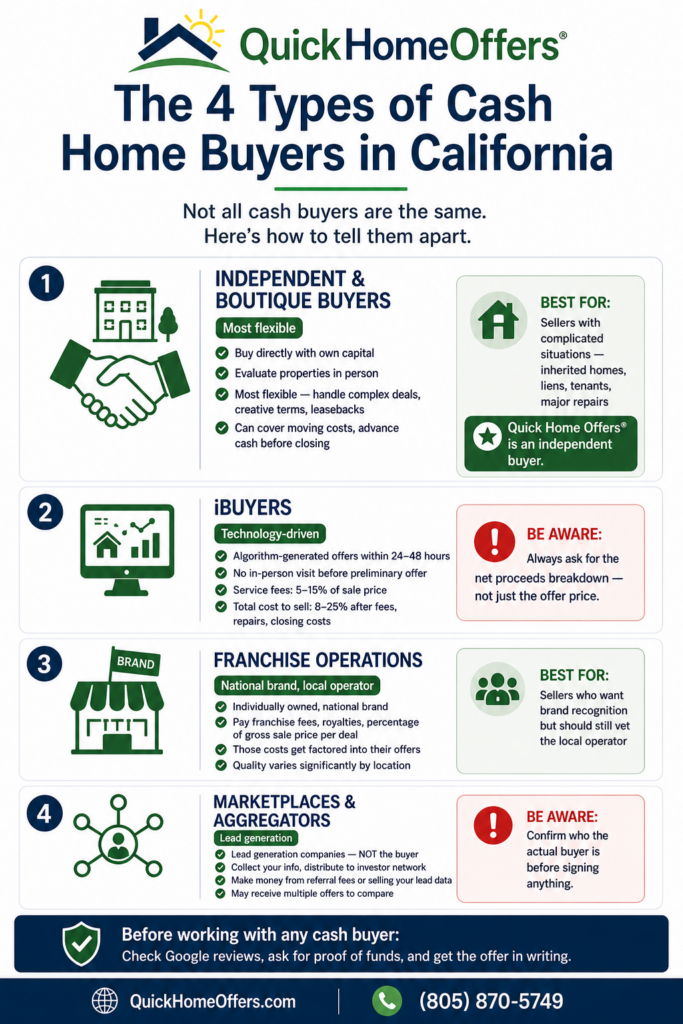
A cash home buyer is a person or company that purchases real estate using cash — no mortgage, no bank approval, no lender-required appraisal. These end buyers assist in moving transactions faster and reducing the number of ways they can fall apart. There are four types operating in California, and the differences matter.
Independent and boutique buyers
Independent cash buyers are locally owned companies or individual investors who buy properties directly. They make their own buying decisions and close with their own capital or a private credit line. Quick Home Offers® is an independent cash buyer.
Independent buyers are the most flexible of the four types. They handle major rehabs, fire damage, title problems, properties with difficult tenants, liens, probate complications, and situations where a seller needs a leaseback or other creative terms. Decisions are made in-house, so each sale can be built around the seller’s situation. Options include cash before closing, moving costs, cleanouts, buying with occupants in place, and leasing the home back after the sale. They also tend to understand the local market better than other buyers.
When choosing a cash home buyer in California, look for a fair price based on an actual property evaluation, not a generic formula. Vetted buyers will show you how the offer was calculated, provide proof of funds, and give you time to make a decision without pressure.
The tradeoff with independent buyers is size. Always ask for proof of funds, experience, and references.
iBuyers
iBuyers are technology companies that use algorithms to generate offers within 24 to 48 hours of submitting your address online. They do not visit your property before making a preliminary offer.
iBuyers work best for homes built within the last 30 years that need only cosmetic updates. If your home has structural issues, unpermitted work, title complications, or tenants, most will decline.
Service fees of 5% to 20% are typical, and repair deductions after their inspection can add thousands more. Total cost to sell through an iBuyer typically runs 8% to 25% of the sale price. Always ask for the net proceeds breakdown before comparing offers.
Franchise operations
Franchise cash buyers are individually owned businesses that operate under a national brand. Franchisees typically pay the franchisor an initial fee and ongoing royalties. Some also pay per-sale fees and marketing fund contributions. Those costs get factored into the offers they make.
Most operate similarly to independent buyers — local operators making their own buying decisions. The brand provides marketing reach, not a guaranteed level of service or pricing. Evaluate them the same way: check reviews, ask for proof of funds, and get your offer in writing.
Cash buyer marketplaces and aggregators
Cash buyer marketplaces are lead generation companies. They do not buy your property. They collect your information and send it to a network of investors, who may or may not contact you with offers. The marketplace makes money by selling your lead information, charging referral fees, or taking a cut of the transaction. The advantage is the ability to receive multiple cash offers and compare offers side by side, which can create competition and push your price up.
The tradeoff is that you are not working with the buyer directly, and the final price may change once the actual investor evaluates the property. Selling directly to one cash buyer means less exposure and no bidding war. It also means more control, a faster closing, and one point of contact throughout the sale.
Marketplaces require the most vetting of the four buyer types. Before signing anything with a marketplace, confirm who the actual buyer is. Verify they are experienced and capable of closing, and ask for proof of funds.
Does the New FinCEN Cash Buyer Rule Affect Me as a Seller?
No. The FinCEN cash buyer rule changes nothing for you as a seller, however it turns out. FinCEN finalized the rule in 2024. It would require title and escrow companies to report the ownership details of companies and trusts that buy homes with cash. The buyer supplies its company information, the closing professionals file the report, and the seller’s side of the sale is untouched: your offer, your timeline, and your proceeds work exactly as they always have.
The rule took effect March 1, 2026. A federal court in Texas vacated it on March 19, 2026, and FinCEN has appealed to the Fifth Circuit. None of that involves sellers. If the rule comes back, it remains the title company’s paperwork, not yours.
Who should consider selling to a cash buyer in California?
A cash sale fits California sellers whose property is hard to sell the usual way. Common reasons are foreclosure, inheritance, vacancy, significant damage, or repairs the seller wants to avoid. For those sellers, a cash buyer is faster, simpler, and sometimes more profitable. If your home is in good condition and you have time to test the open market, listing with an agent is likely the smarter path. Cash buyers purchase properties in any condition, including homes with mold damage, fire damage, or code violations.
Quick Home Offers® has closed over 300 California transactions since 2013, and about 1 in 3 were inherited or in probate. Every property we have taken on needed work. Cash sales are typically not for people with new homes or newly remodeled homes.
Inherited property
A cash sale lets heirs sell an inherited house that needs work without paying for repairs first. Carrying costs such as taxes, insurance, utilities, and sometimes a mortgage add up every month. When several heirs are involved, disagreements can stall a sale for months. A cash sale lets every heir walk away with proceeds, with no repairs, no cleaning, and no listing that may take 90 days or longer to close.
Title issues, liens, and code violations
Tax liens, judgment liens, mechanic’s liens, open permits, unpermitted additions, and code enforcement cases stop most traditional sales. Lenders will not finance a property with unresolved title or compliance problems. Cash buyers can work through these issues, often resolving them at or after closing, so the seller does not have to.
Tenants, squatters, or occupied properties
A cash buyer can purchase a property with tenants or squatters still in place and handle the occupancy after closing. On the open market, a tenant-occupied property has fewer buyers and harder showings. If tenants have stopped paying or squatters have moved in, most buyers and their agents will not touch it. Experienced cash buyers can often work through that situation.
Deferred maintenance and major repairs
A cash buyer takes a house that needs major repairs as-is and prices the repair costs into the offer. A failing roof, foundation cracks, mold, fire damage, and outdated electrical or plumbing are expensive to fix, and they scare off retail buyers. Selling as-is in California can mean losing 5% to 30% of your home’s after-repaired fair market value. Listing a property that needs $50,000 or more in work means waiting months for a buyer willing to take on the project, then negotiating repair concessions on top of that. A cash buyer takes the property as-is and factors the repair costs into the offer.
Selling as-is in California means the seller does not have to make repairs, even if the buyer’s inspector finds issues. The seller must still disclose all known defects.
Foreclosure, divorce, or financial hardship
When a foreclosure date, a divorce settlement, or carrying costs force a sale, speed matters more than the last dollar of price. Cash sales can close in as little as 7 days when needed.
Out-of-state owners
Out-of-state owners can sell a California property to a cash buyer without ever visiting it. A traditional listing means coordinating agents, contractors, inspectors, and showings from a distance. About half of Quick Home Offers® transactions have closed remotely. Whether you own property in San Diego, Los Angeles County, the Central Coast, the Central Valley, or the Bay Area in California, we handle the entire process remotely if needed.
Cash Offer vs. Listing With an Agent: What You’ll Actually Net
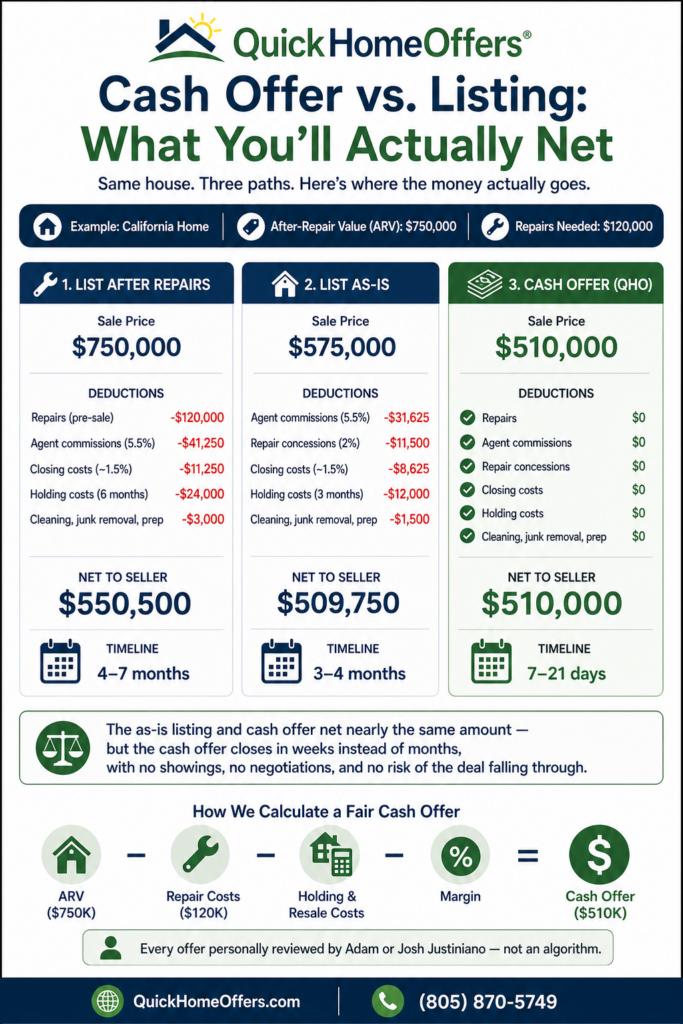
What you actually net is the money deposited in your bank account after every cost comes out of the sale price. The contract price alone does not tell you that. A top agent may help you sell closer to full market value. You will also pay commissions, cover repair concessions, and wait months to close. A cash offer comes in lower on paper but eliminates those costs entirely.
Here is what that looks like on the same property sold three different ways.
Compare Options: California home with an after-repair value of $750,000
The example home needs about $120,000 in repairs. The seller has three options. They can invest in the repairs and list at full value, list as-is, or accept a cash offer and close in two weeks.
| List After Repairs | List As-Is | Cash Offer (QHO) | |
|---|---|---|---|
| Sale price / offer | $750,000 | $575,000 | $510,000 |
| Repair costs (pre-sale) | −$120,000 | $0 | $0 |
| Agent commissions (5.5%) | −$41,250 | −$31,625 | $0 |
| Repair concessions (2%) | $0 | −$11,500 | $0 |
| Seller closing costs (~1.5%) | −$11,250 | −$8,625 | $0 |
| Holding costs (3–6 months) | −$24,000 | −$12,000 | $0 |
| Deep cleaning, junk removal, prep | −$3,000 | −$1,500 | $0 |
| Net to seller | $550,500 | $509,750 | $510,000 |
| Time to close | 4–7 months | 3–4 months | 7–30 days |
The seller who lists after completing $120,000 in repairs nets the most — about $40,000 more than the cash offer. But that requires spending $120,000 out of pocket, managing contractors for months, and carrying the property the entire time. If the rehab goes over budget or the market shifts during that period, the gap shrinks or disappears.
The seller who lists as-is nets roughly the same as the cash offer. That seller waits 3 to 4 months and faces showings, negotiations, and the risk of a buyer backing out after inspection or a failed appraisal.
The cash offer nets $510,000 with no upfront costs, no repairs, no showings, and a closing date the seller controls.
No option is right for every seller. Check market conditions before you accept any offer. If you have the cash and time to invest in repairs and can afford to carry the property for 6 months, listing after repairs will probably net you more. If you do not have that runway, a cash sale gets you to a similar as-is number faster.
…they gave me $3000 before we even closed…
They gave me an offer within about a day and closed on the date of my choice. They gave me $3000 before we even closed to help move my brother-in-law out of the house. They offered to help them move out as well. These are two nice young men who delivered on their promise and closed on the date I chose.
Get a cash offer today from one of California’s most experienced cash home buyers. Quick Home Offers® has closed over 300 transactions across California since 2013.
Enter your number. We’ll walk through your options — whether you sell to us or not. No fees. No obligation. Serving California since 2013.
Call or text (805) 870-5749 or submit your address above for a no-obligation cash offer. Whether you need to sell your house fast or want time to decide, we work on your schedule.
How We Calculate Your Fair Cash Offer
Quick Home Offers® calculates your cash offer from three numbers. They are the after-repair value, the cost of repairs, and the cost of holding and reselling the home. Most cash buyers use the same three numbers.
After-repair value (ARV) — what the market value would be for a fully renovated property based on recent comparable sales.
Estimated repair costs — materials, labor, permits, and a contingency for surprises.
Costs and margin — holding costs during renovation, resale closing costs, and the buyer’s margin for taking on risk.
The formula: ARV − repair costs − holding costs − resale costs − margin = cash offer
Example: ARV of $750,000 − $120,000 in repairs − holding, resale costs, and margin = approximately $510,000 cash offer. That $510,000 is what the seller deposits with no commissions, no closing costs, and no deductions.
Every offer at Quick Home Offers is personally reviewed by Adam or Josh Justiniano — not generated by an algorithm. Some sellers have a tenant who needs 60 days to move, an open code enforcement case, or an inherited home with title problems. Quick Home Offers® structures each sale around those facts. We can adjust closing timelines, cover unexpected costs, or structure the transaction to put more money in the seller’s pocket than a standard formula would produce. If a cash offer is not the best option for your situation, we will tell you.
How the cash sale process works in California
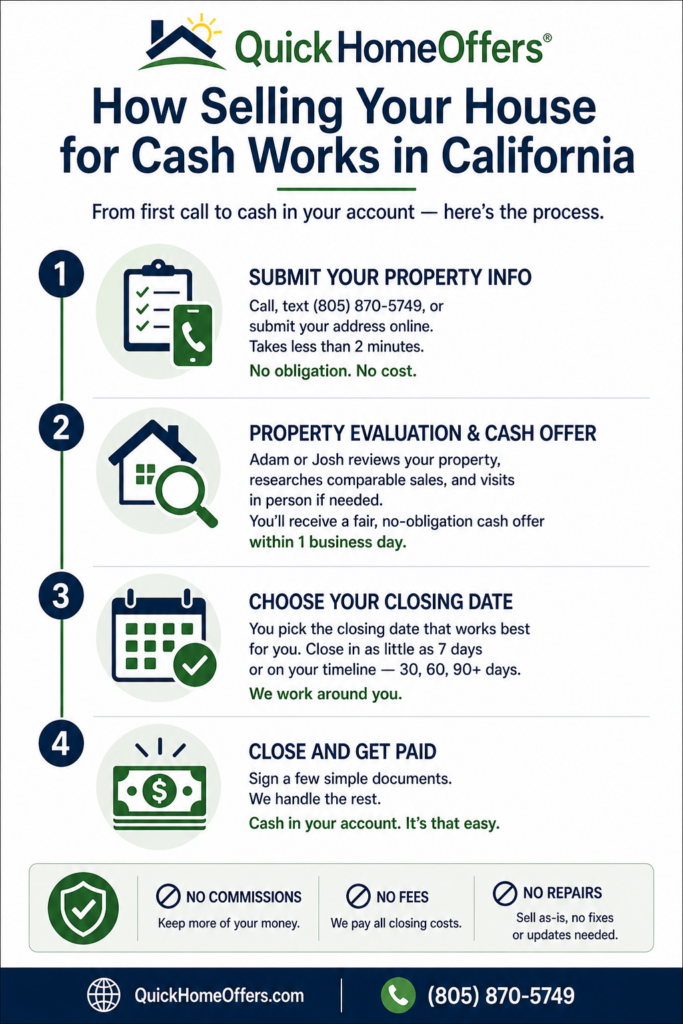
Step 1 – Submit your property information
Call, text (805) 870-5749, or fill out the form on our website with your property address and some basic information about your situation. You’ll receive a no-obligation offer at no cost. We buy houses, condos, multifamily properties, and land anywhere in California. Whether you need to sell your house fast or are exploring your options, submitting your information is free and carries no obligation.
Step 2 — Property evaluation and cash offer
Adam or Josh will review your property details and research comparable sales. Someone from our team sees every property in person before closing. You will receive a fair, no obligation cash offer — typically within one business day. The offer is yours to accept or decline — no pressure and no expiration. Our goal is to deliver fast cash offers that reflect the actual condition and value of your property — not a lowball number designed to be renegotiated later.
Step 3 — Choose your closing date
If you choose to accept your offer, you choose the close date. From there, an escrow company will facilitate the closing. We have closed in as few as 7 days when a seller needed to move fast. We have also waited 90 days or more when a seller needed time. If your situation changes after you accept, we can adjust.
Step 4 — Close and get paid
Quick Home Offers® closes through a local title company. There are no agent commissions, no closing costs on your side, and no last-minute fees. The net proceeds from your cash offer are deposited directly into your account on the closing date you chose. There are no hidden fees, no service fees, and no surprise deductions at closing. Apart from any mortgage, liens, taxes, or fines, the offer we present is the amount you receive.
In California, sellers are required to complete a Transfer Disclosure Statement (TDS) even in a cash sale. We walk sellers through this process and handle the paperwork.
Who Pays Closing Costs When You Sell a House for Cash in California?
In a California home sale, the purchase agreement decides who pays each closing cost, and local custom shapes those terms. When you sell to Quick Home Offers®, we cover your closing costs. That includes both sides of the escrow and title fees.
Escrow fees are paid to a neutral third party that facilitates the transaction, the paperwork, and the recording of the sale. Title fees pay for the title insurance policy. California also lets each county charge a documentary transfer tax of 55 cents for every $500 of value when the deed is recorded. A city can charge a share of that tax too (Revenue and Taxation Code §11911).
If your home is listed with an agent, your listing agreement controls the agent’s commission. You usually still owe your agent’s commission when the buyer pays cash.
What this can mean for you: Ask any cash buyer for a written list of the costs they cover. Your mortgage payoff, liens, back property taxes, and any fines still come out of the sale proceeds at closing. About 1 in 4 of the properties Quick Home Offers® has taken on had a lien beyond the mortgage. In nearly every case, the lien was paid through escrow and the seller did not have to come out of pocket for it.
This is general information, not legal advice. For help with your situation, talk with a California real estate attorney or your escrow company.
Quick Home Offers® Case Study: A Fire-Damaged Lompoc House on California’s Central Coast
Quick Home Offers® bought a fire-damaged house on East Lemon Avenue in Lompoc as-is, after the owner’s rebuild had stalled for years. We rebuilt it ourselves, and the seller paid nothing for repairs, permits, or cleanup.
- Situation
- Fire-damaged 3-bed, 2-bath single-family home in Lompoc (built 1962), vacant for years
- Challenge
- Interior gutted to the framing, every major system needing replacement, a stalled rebuild, and squatters during the vacancy
- What we did
- Bought the home as-is for cash, then took on the full permitted gut rebuild
- Outcome
- The owner walked away with no repairs, permits, or cleanup
- Closing speed
- Closed the purchase in about two weeks
- The rebuild
- Complete gut renovation, finished and back on the market in about four months
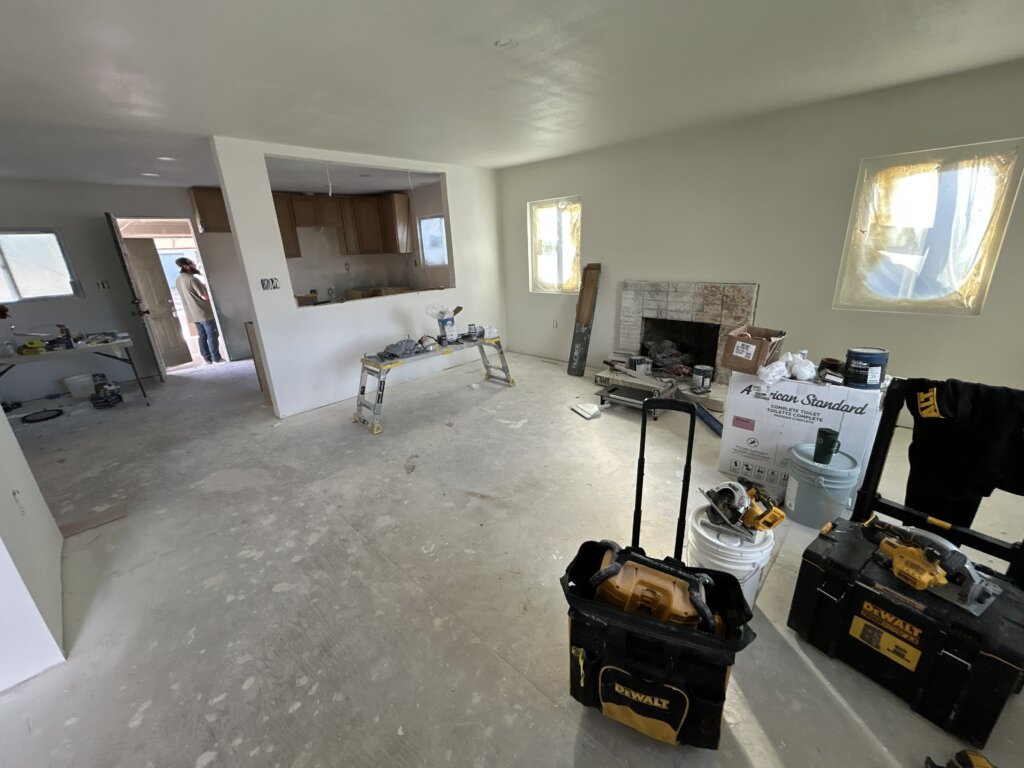
In 2021, a fire caused extensive damage to a home on East Lemon Avenue in Lompoc in California’s Central Coast. Thankfully, the dog was rescued, and no injuries were reported. The owner dealt with the insurance process, eventually resolved the claim, and hired a contractor to rebuild, but project stalled due to unforeseen events.
By the time the owner reached out to us, years had passed since the fire. The interior was completely gutted — only framing remained. Every major system needed to be replaced: electrical, plumbing, HVAC, roofing, drywall, and finishes. On top of that, the property had attracted squatters while it sat vacant. The seller handled the squatter situation herself before contacting us.
We purchased the home as-is — no repairs, no permits, and no cleanup required from the seller. We took on the full rebuild, handled all permitting through the City of Lompoc, and completed the renovation. The seller walked away without spending another dollar or another month dealing with a property that had consumed years of her time and energy.
No pricing algorithm could evaluate a gutted, fire-damaged Lompoc home with a stalled renovation and a squatter history. It required an in-person visit, a detailed scope of work, and a buyer willing to take on a project that most investors would pass on.
Frequently asked questions about selling to a cash buyer in California
How much do cash buyer companies in California pay?
California cash buyers usually pay the after-repair value minus repairs, holding and resale costs, and their margin. Quick Home Offers® does not use a fixed percentage. We calculate each offer from the actual repair scope and the seller’s timeline and circumstances. The right way to evaluate any cash offer is to compare net proceeds — what you actually deposit into your bank account.
Most California cash buyers use the “70% rule” — they offer 70% of the after-repair value minus estimated repair costs. That formula is designed to protect the buyer’s margin, but it often leads to lowball offers that do not account for the seller’s specific situation.
What is the process of selling a house for cash as-is?
Selling a house as-is to Quick Home Offers® in California takes 4 steps: submit the property, get an offer, pick a closing date, and close.
You submit your property information by phone, text, or online form. The process is fast — we review comparable sales, evaluate your situation, and typically visit the property in person. You receive a no-obligation cash offer, typically within one business day, with no pressure or commitment required. If you accept, you choose a closing date, and the sale closes through a local title company. Most of our sales close in 7 to 30 days.
Do I need a real estate agent to sell to a cash buyer?
No. A direct cash sale has no real estate agent on either side, so you pay no commissions. Commissions typically run 5% to 6% of the sale price in California. You negotiate directly with the buyer, and the transaction closes through a title company and escrow, just like any other real estate sale. Some sellers hire a real estate attorney to review the purchase agreement, which is an option but not a requirement in California.
A flat fee MLS listing is another route if you want open-market exposure with lower commissions. You pay a flat fee to list on the MLS and handle showings and negotiations yourself.
A flat fee listing works best for homes in good condition that will attract retail buyers. For most homeowners whose property needs major work, has title issues, or must close quickly, a direct cash sale typically makes more sense. That holds against both a full-service agent and a flat fee listing.
How fast can I sell my house for cash in California?
Most Quick Home Offers® sales close in 7 to 30 days. A cash sale skips the mortgage approval, appraisal, and lender requirements that delay a traditional sale. The primary factor is how long it takes to clear title. If there are liens, open probate, or title complications, it can take longer. Sellers can also request a longer timeline from Quick Home Offers if they need more time to move.
What is the difference between an iBuyer and a cash home buyer?
An iBuyer is a technology company that uses algorithms to generate offers without visiting your property. Service fees typically run 5% to 20%, plus repair deductions after inspection — total costs can reach 8% to 25% of the sale price. If your home is newer and only needs cosmetic updates, an iBuyer can be a solid option: fast, mostly online, minimal effort.
The tradeoff is flexibility. You get a number, you accept or decline, and there is no room to negotiate terms beyond price. Properties with foundation problems, unpermitted work, mold, tenants, or title issues are usually declined.
A direct cash buyer like Quick Home Offers works differently. Adam or Josh evaluates the property, and the offer reflects what we actually see. No service fees, no repair deductions, no surprise adjustments at closing. We also structure each sale around the seller’s situation: leasebacks, cash advances before escrow closes, moving assistance, junk removal, local resource referrals, help with tenant situations, and more. Some homeowners who contact us have already been declined by an iBuyer or received an offer that dropped significantly after inspection.
Do I have to pay taxes when I sell my house for cash?
The method of payment does not change your tax obligations. If you sell for a profit, you may owe federal and California state capital gains taxes. The federal home sale exclusion may cover up to $250,000 in gains. It applies if the house was your primary residence for at least two of the last five years. Married couples filing jointly may exclude up to $500,000. If you inherited the property, the stepped-up cost basis often eliminates or significantly reduces capital gains taxes. Consult a tax professional for your specific situation.
Are California cash home buyer companies legitimate?
Most cash home buyers in California are legitimate, but sellers should check reviews and verify credentials to avoid potential scams. Before accepting any offer, check the buyer’s Google reviews and track record. Ask for a proof of funds letter confirming they have the cash to close. Confirm the buyer has experience with properties like yours, and confirm they are the actual buyer. A legitimate buyer will welcome these questions. If anyone pressures you to sign immediately or refuses to provide proof of funds, walk away.
Should I get multiple cash offers before accepting?
Yes – if your timeline allows it, getting multiple cash offers is worth the effort. Contacting multiple cash buyers gives you a better sense of what your property is worth.
When comparing cash offers, do not compare sale price — compare net proceeds. A $520,000 offer with no fees, no closing costs, and a cash advance for moving may net you more than a $545,000 offer. That happens when the higher offer deducts a 5% service fee and $8,000 in repair credits. Ask every buyer for a written breakdown showing exactly what you will deposit into your account at closing. If any buyer refuses to provide that, move on.
Do I still have to disclose problems with my house in a cash sale?
Yes. California law requires a Transfer Disclosure Statement on most home sales, including sales to a cash buyer. Some sales are exempt, such as sales ordered by a probate court. You must disclose known material defects to the buyer, however you sell. These include foundation issues, water damage, mold, unpermitted work, roof problems, and anything affecting the home’s value or habitability. Selling as-is does not remove this obligation. This does not mean you need to go looking for issues. The Transfer Disclosure Statement only pertains to what you know.
Can I sell my house for cash if I still have a mortgage?
Yes. The existing mortgage is paid off through escrow at closing, just like in a traditional sale. As long as the cash offer covers your remaining loan balance plus any liens or other encumbrances, you can sell. If you owe more than the offer amount, you would need to bring the difference to closing or negotiate a short sale with your lender.
What types of properties do cash buyers purchase in California?
Cash home buyers in California purchase single-family homes, condos, multifamily properties, vacant land, and commercial properties in rare cases. Quick Home Offers® often buys properties with fire damage, mold, foundation problems, unpermitted work, code violations, tenant issues, or title complications. It also buys properties the owner simply no longer wants. Every property Quick Home Offers® has taken on needed work.
Can I stay in my house after selling to a cash buyer?
In many cases, yes, depending on the buyer. Some cash buyers offer leaseback arrangements or flexible move-out timelines so you can remain in the home for a set period after closing. Quick Home Offers® sets a move-out schedule that fits each seller. That can mean closing in 7 days or staying in the home for a while after the sale.
Can a cash buyer change their offer after seeing the property?
Whether a cash buyer can change their offer depends on the buyer and the contract. Some cash buyers, especially iBuyers, make a preliminary offer from your online submission. Some of them lower it after their inspection, sometimes by tens of thousands of dollars. Price cuts after inspection are one of the most common complaints sellers report. At Quick Home Offers®, Adam visits properties in person before drafting a written offer whenever possible. Our price changes only if our in-person visit finds something material that was not disclosed in our earlier conversations about the property.
Can a cash buyer help with moving costs, cash advances, or other expenses?
Most cash buyers do not offer financial assistance beyond the purchase price. At Quick Home Offers, we regularly help sellers with costs that go beyond the sale itself, including:
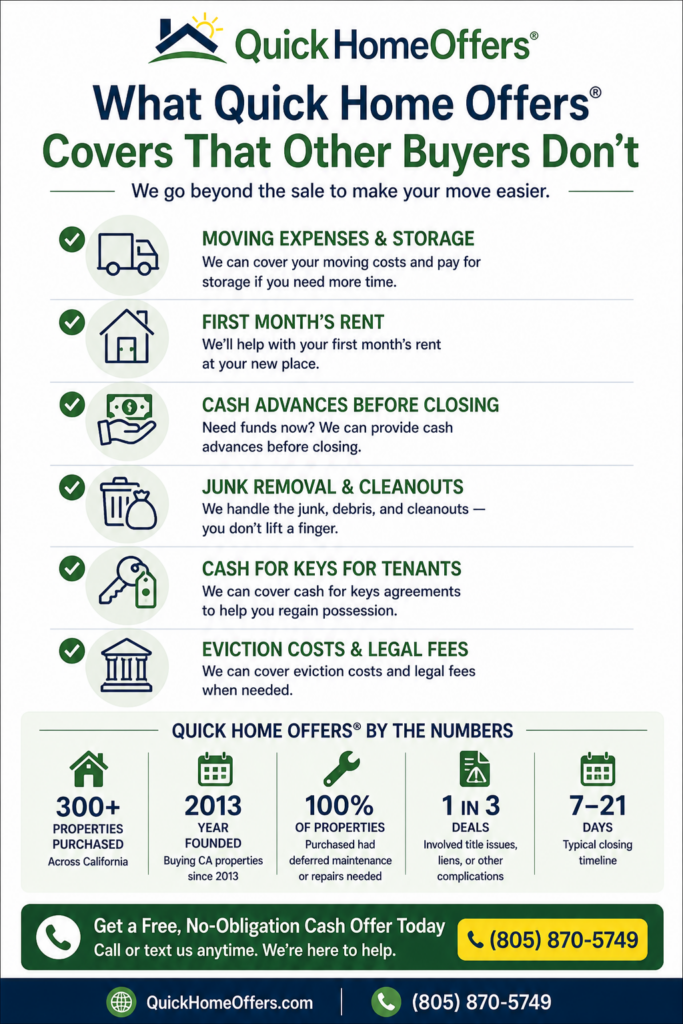
Covering moving expenses, storage units, and the first month’s rent at a new place. Advancing cash to sellers before closing for urgent expenses — rent, medical bills, or overdue payments. Paying for junk removal, cleanouts, and hauling away personal items left behind. Offering cash for keys to tenants so they relocate voluntarily, and the seller avoids a lengthy eviction. Covering eviction costs and legal fees when tenants will not cooperate. Donating usable furniture and personal items on the seller’s behalf after closing.
There is no separate charge to the seller. If you need help with any of these, tell us early so we can set aside funds and coordinate. Adam or Josh Justiniano reviews every Quick Home Offers® property personally instead of using a formula. A standard cash offer cannot account for what a seller actually needs to move on.
Sell Your House Fast Without Repairs
Quick Home Offers® purchases houses, condos, multifamily properties, and land in any condition throughout California. No repairs. No hidden fees. No open houses. No obligation. Call or text (805) 870-5749 or submit your property address below to receive a fair cash offer — typically within one business day.
Enter your number. We’ll walk through your options — whether you sell to us or not. No fees. No obligation. Serving California since 2013.
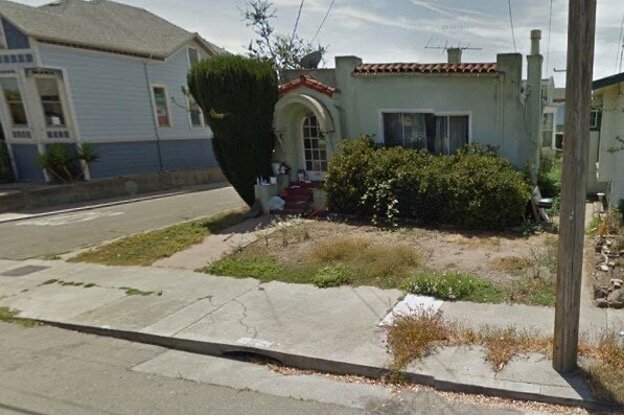
Made a very difficult time in my family’s life a little easier.
From the moment we were in contact with Adam, things went smoothly, quickly, and very professionally. Adam was compassionate and was very sensitive to our situation. This house was looked at, sold, and went through escrow in 2 weeks!! All around was just a wonderful experience. Made a very difficult time in my family’s life a little easier.
About the Authors and Quick Home Offers®

Adam and Josh Justiniano are the founders of Quick Home Offers, a California cash home buying company established in 2013. They have closed over 300 California transactions, from San Diego to the Bay Area, including houses, condos, multifamily properties, and land. We buy houses in any condition — fire-damaged, tenant-occupied, with liens, probate, code violations, or simply outdated. If you need to sell a house in California, we will make you a fair cash offer.
Adam handles seller relations and personally evaluates properties in the field. Josh manages underwriting, marketing, and project oversight. Every offer is reviewed by one or both of them before it reaches a seller.